Rottweiler vs Doberman: Which Breed Is Right for You?
Rottweiler or Doberman? Compare size, temperament, training, exercise, family life, health, shedding, lifespan and costs to find the right breed for you.
Choosing between a Rottweiler and a Doberman can be difficult. Both are intelligent, loyal and powerful working breeds, but living with them can feel very different.
A Rottweiler is generally heavier, more powerfully built and often more deliberate in temperament. A Doberman is leaner, more athletic and typically demands a highly active lifestyle with plenty of mental stimulation. Both require early socialization, consistent reward-based training and an owner prepared for a strong working breed.
This Rottweiler vs Doberman comparison covers size, temperament, training, exercise, family life, children, grooming, health, lifespan and ownership costs — then helps you decide which breed better matches your lifestyle. Updated for 2026.
Rottweiler vs Doberman: Quick Answer
Choose a Rottweiler if you…
- prefer a heavier, powerfully built dog;
- like a confident, more deliberate working-dog temperament;
- can provide consistent training and socialization;
- want a dog that can enjoy an active lifestyle without needing constant high-intensity activity;
- are prepared for the food, equipment and healthcare costs of a very large dog.
Choose a Doberman if you…
- want a leaner, highly athletic dog;
- enjoy frequent training and mental challenges;
- can provide substantial daily physical and mental activity;
- want a dog that often stays very closely connected to its owner;
- are prepared to take breed-specific health screening seriously.
Still unsure? Take our free Rottweiler vs Doberman Quiz →
Rottweiler vs Doberman at a Glance
| Category | Rottweiler | Doberman Pinscher |
|---|---|---|
| Origin | Germany, Roman drover dog descendant | Germany, bred by Karl Dobermann (1890s) |
| General build | Heavy, muscular, powerful | Lean, athletic, agile |
| Height (male) | 24–27 in (61–69 cm) | 26–28 in (66–72 cm) |
| Weight (male) | 95–135 lb (43–61 kg) | 75–100 lb (34–45 kg) |
| Energy level | Moderate–high | High–very high |
| Training | Highly trainable; can be deliberate | Highly trainable; often quick and responsive |
| Exercise | High (1.5–2 hrs/day) | Very high (2+ hrs/day) |
| Family suitability | Can be excellent with training and socialization | Can be excellent with training and socialization |
| Children | Supervision + socialization essential | Supervision + socialization essential |
| Grooming | Low-maintenance | Low-maintenance |
| Shedding | Moderate (double coat) | Generally lighter (short single coat) |
| Protection instinct | Strong | Strong |
| First-time owner | Challenging | Challenging |
| Typical lifespan | 8–10 years | 10–13 years |
| Best fit | Owner wanting a powerful, steady companion | Very active owner wanting an athletic companion |
Rottweiler vs Doberman: The Biggest Differences
1. Body type
Rottweilers are heavier and more powerfully built; Dobermans are leaner and more athletic.
2. Energy
Both are active, but Dobermans generally suit owners who want a particularly energetic companion.
3. Temperament
Rottweilers are often more deliberate; Dobermans are often more immediately responsive and sensitive.
4. Training style
Both benefit from positive, consistent training rather than intimidation or harsh corrections.
5. Grooming
Both are relatively low-maintenance, but coat structure and shedding differ.
6. Health
Both have important breed-specific health concerns worth discussing with a veterinarian.
7. Lifestyle fit
The best choice depends more on the owner's routine and experience than on appearance.
Not sure which sounds more like you? Take the breed-match quiz.
Rottweiler vs Doberman Size and Weight
Which Is Bigger: a Rottweiler or a Doberman?
Rottweilers are generally heavier and broader, while Dobermans are often taller-looking because of their leaner, more athletic frame. Adult male Rottweilers typically stand 24–27 in (61–69 cm) and weigh 95–135 lb (43–61 kg); adult male Dobermans typically stand 26–28 in (66–72 cm) and weigh 75–100 lb (34–45 kg). Females of both breeds are usually smaller and lighter.
Average adult male weight (lb)
Source: AKC breed standards.
Rottweiler vs Doberman Build
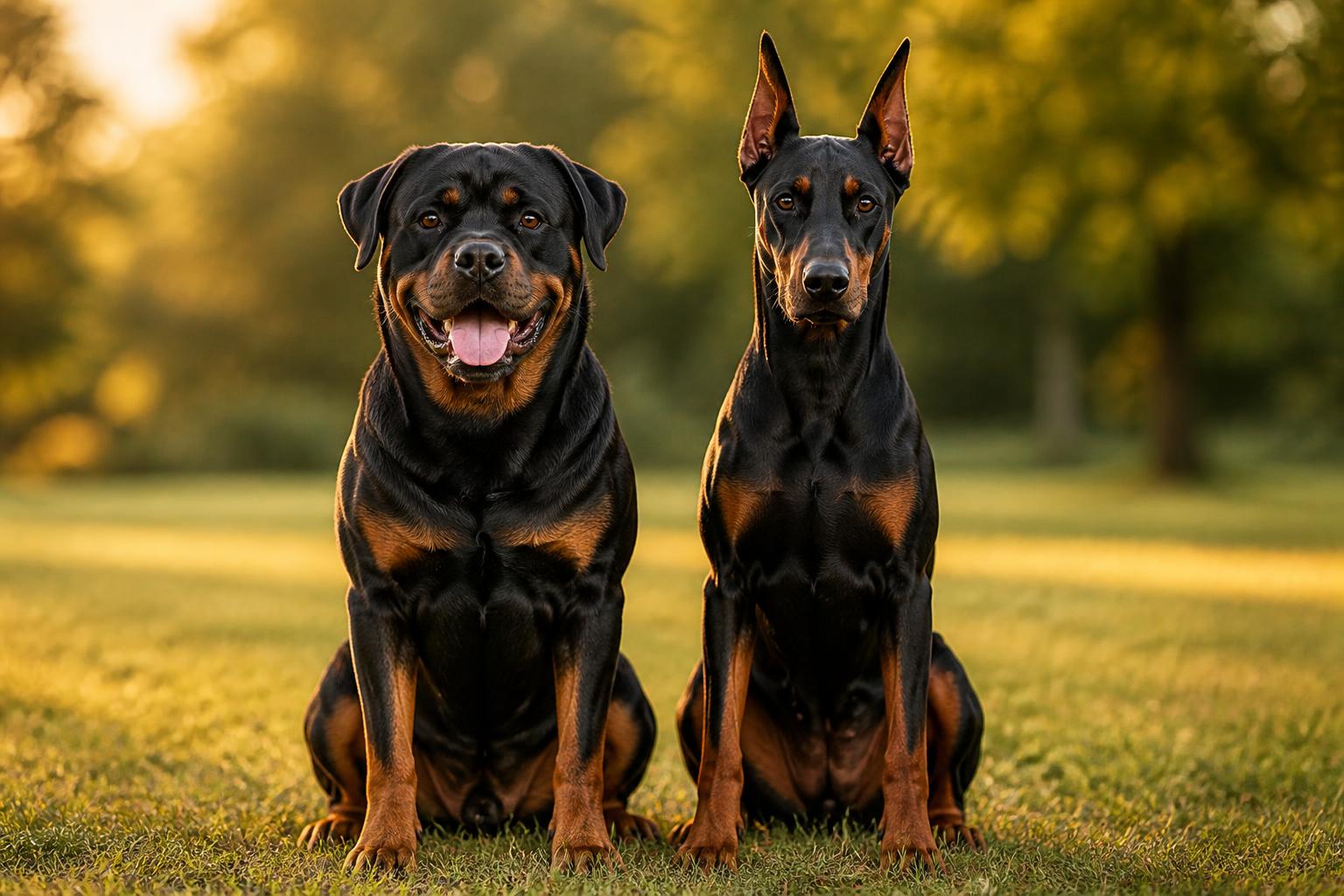
The Rottweiler has a broad chest, heavy bone and a compact, muscular body originally suited to droving and pulling work. The Doberman is narrower and leaner, built for speed and endurance. That difference in build affects everything from crate and harness sizing to how much food each dog needs.
Rottweiler vs Doberman Appearance
Both breeds share a black-and-tan (or black-and-rust) pattern, which is why people confuse them from a distance. Up close the differences are clear: the Rottweiler has a broad, blocky head with a wide muzzle and a heavier body outline, while the Doberman has a longer, more wedge-shaped head and a sleek, tucked-up silhouette.
Coat also differs. Rottweilers carry a short double coat with a dense undercoat; Dobermans have a very short, close-lying single coat. Markings on both breeds usually appear over the eyes, on the cheeks, chest and legs.
Naturally, both breeds have drop ears and a full tail. Cropped ears and docked tails are cosmetic practices, not breed requirements, and they are restricted or banned in many countries — always check the rules where you live and speak to your veterinarian.
Rottweiler vs Doberman Temperament and Personality
Both breeds can be loyal, confident and deeply bonded to their families, but breed tendencies are not guarantees. Genetics, breeding, early socialization, training and individual personality all matter.
Rottweiler Temperament
Rottweilers are typically confident and deliberate. They are strongly family-oriented, often reserved with strangers, and they tend to observe a situation before reacting. They need early socialization, clear and consistent boundaries, and an owner who is present in daily life.
Doberman Temperament
Dobermans are typically alert, athletic and highly people-oriented — many owners describe them as constant companions. They can be sensitive to tone and handling, and they need genuine mental engagement alongside consistent training.
Which Breed Is Calmer?
As a broad breed tendency, many owners find mature Rottweilers more deliberate and Dobermans more continuously alert and energetic. Individual dogs can differ significantly, and a poorly exercised or under-socialized dog of either breed will not feel calm.
Our Rottweiler socialization guide explains how to build confident behaviour in the first months.
Rottweiler vs Doberman Training: Which Is Easier to Train?
Both breeds are intelligent and capable learners. Dobermans are often quick and responsive during training, while Rottweilers can be more deliberate and may test consistency. Neither breed should be trained through intimidation or harsh punishment.
Focus your training plan on puppy socialization, reward-based marker training, impulse control, reliable recall, loose-leash walking, calm greetings, and comfortable handling for grooming and veterinary care. Just as important: consistency between everyone in the household, so the dog gets the same rules from every person.
For step-by-step plans, see our Rottweiler training guide and the Rottweiler puppy training guide — the reward-based methods apply equally well to a Doberman.
Rottweiler vs Doberman Exercise Needs
Dobermans generally need more daily activity than Rottweilers — plan on at least two hours of active work per day plus mental enrichment. Rottweilers usually do well on 1.5–2 hours and often prefer strength-based games such as tug, controlled fetch and structured walks over long-distance running.
Neither breed suits a home where the dog is alone for long hours with little to do. Both can live happily in a house or an apartment with committed daily exercise, but boredom quickly turns into chewing, barking and anxiety. Sniffing walks, training games and puzzle feeding count as exercise too.
Rottweiler vs Doberman as Family Dogs and With Children
Both breeds can live successfully in families, and neither is automatically the safer choice. What matters is responsible breeding, individual temperament, early socialization, consistent training and adult supervision around children.
Practical rules help more than breed labels: supervise all interactions between dogs and young children, teach children to leave a resting or eating dog alone, give the dog a quiet retreat space such as a crate or bed, and reward calm behaviour around visitors. Because both breeds are large and strong, teaching a solid "four paws on the floor" greeting early prevents accidental knocks.
Rottweiler vs Doberman Protection and Guarding Instinct
Both breeds are naturally watchful and were developed for guarding and protection work. In a normal home, that instinct shows up as alertness rather than anything dramatic — a dog that notices visitors and looks to its owner for direction.
The responsible goal is a stable, well-socialized dog under control, not a dog encouraged to be suspicious or reactive. Protection sports or professional protection training should only ever be done with an experienced, qualified trainer.
Rottweiler vs Doberman Grooming and Shedding
Dobermans have a short, single coat that sheds relatively little — a weekly rub-down with a rubber mitt is usually enough. Rottweilers have a short double coat that sheds moderately year-round with heavier moults in spring and autumn, so brushing 1–2 times per week helps a lot.
Beyond coat care, both breeds need regular nail trimming, ear checks, dental care and skin inspection. See our Rottweiler grooming guide for a simple routine, and the grooming tools buyer's guide for the kit that works on a short double coat.
Rottweiler vs Doberman Health Problems
Both breeds have breed-specific health concerns, and neither is free of risk. Dobermans are strongly associated with dilated cardiomyopathy (DCM) and von Willebrand disease, so cardiac and DNA screening in breeding lines matters. Rottweilers are more commonly associated with hip and elbow dysplasia, osteosarcoma and gastric dilatation-volvulus (bloat).
Choosing a breeder who health-tests the parents is the single biggest thing you can do to reduce risk, whichever breed you pick. Discuss screening, diet and joint development with your own veterinarian — this article is general information, not veterinary advice. See our common Rottweiler health issues guide and Rottweiler nutrition guide.
Because treatment for conditions like DCM or joint surgery can be expensive, many owners look at cover early — our Rottweiler pet insurance guide explains what to check before signing up.
Rottweiler vs Doberman Lifespan
Rottweilers typically live around 8–10 years and Dobermans around 10–13 years. These are population averages: individual lifespan depends on genetics, body condition, preventive care and luck. Keeping your dog lean, exercised and up to date with veterinary checks is the practical way to influence it.
Average lifespan (years)
Source: veterinary longevity studies.
Rottweiler vs Doberman Cost of Ownership
Purchase price is broadly similar from a reputable, health-testing breeder. Running costs are also comparable, though Rottweilers usually eat more and need larger crates, beds and harnesses, while veterinary costs for either breed can rise sharply if a breed-specific condition appears.
Budget for food, preventive veterinary care, vaccinations, parasite control, training classes, equipment, grooming supplies, insurance and emergency care. Use our Rottweiler cost calculator to estimate monthly and lifetime costs — most figures translate well to a Doberman.
Rottweiler vs Doberman for First-Time Owners
Neither breed is an easy first dog. Both are large, strong, intelligent working breeds that notice inconsistency and need daily investment. A first-time owner can succeed, but only with realistic expectations, professional training support and a household that agrees on the rules.
Choose a Rottweiler if you prefer a heavier, more deliberate dog and can commit to firm but positive training. Choose a Doberman if you enjoy frequent training, can provide substantial mental engagement, and are comfortable with a sensitive, closely bonded working dog. If you are preparing for a puppy either way, our puppy preparation checklist covers what to have ready before day one.
Rottweiler and Doberman: Pros and Considerations
Rottweiler
Pros
- loyal and family-oriented;
- powerful and versatile;
- intelligent and trainable;
- strong bond with its people.
Considerations
- very strong physically;
- requires training and socialization;
- substantial food and equipment costs;
- breed-specific health risks;
- moderate shedding.
Doberman
Pros
- athletic and agile;
- intelligent and highly trainable;
- people-oriented;
- relatively easy coat care.
Considerations
- high activity needs;
- needs daily mental stimulation;
- can be sensitive to harsh handling;
- breed-specific health risks;
- requires consistent socialization and training.
Rottweiler or Doberman: Which Breed Is Right for You?
Choose a Rottweiler if…
- you prefer a heavier, powerful working dog;
- you appreciate a more deliberate temperament;
- you can commit to early training and socialization;
- you can manage the cost and physical strength of a large breed;
- you want an active companion but do not specifically need an ultra-athletic dog.
Choose a Doberman if…
- you want a lean, athletic working dog;
- you have a highly active lifestyle;
- you enjoy regular training and mental challenges;
- you want a dog that is often highly engaged with its owner;
- you are prepared for important breed-specific health screening.
Still Can't Decide?
Reading breed comparisons helps, but your daily routine matters just as much as height, weight or appearance. Our free quiz asks about your activity level, home, training experience, grooming preferences and the time you can dedicate to a dog.
Take the Free Rottweiler vs Doberman Quiz
Find out which breed better matches your lifestyle in just a few questions.
Frequently Asked Questions About Rottweilers vs Dobermans
Is a Rottweiler better than a Doberman?
There is no universally better breed. A Rottweiler may better suit someone who wants a heavier, more deliberate companion, while a Doberman may better suit someone looking for a highly athletic, energetic dog. Lifestyle fit matters more than declaring a winner.
Which is bigger, a Rottweiler or a Doberman?
Rottweilers are generally heavier and broader. Dobermans can be tall but have a much leaner, more athletic build.
Which is easier to train, a Rottweiler or Doberman?
Both are highly trainable. Dobermans are often quick and responsive, while Rottweilers can be more deliberate. Consistency and reward-based training matter with both.
Which is more intelligent, a Rottweiler or Doberman?
Both are intelligent working breeds. Intelligence cannot be reduced to a single ranking, and practical trainability varies by individual dog, motivation and handler.
Which is better with children?
Neither breed is automatically better. Responsible breeding, individual temperament, socialization, training and adult supervision are critical.
Which breed needs more exercise?
Both require substantial daily activity, but Dobermans generally have the higher ongoing need for athletic activity and mental stimulation.
Which sheds more?
Rottweilers generally shed more because of their double coat. Dobermans have a very short coat and typically require less coat maintenance.
Which breed is more protective?
Both can be naturally watchful. Responsible owners should prioritise stable temperament, socialization and control rather than encouraging aggression.
Which breed lives longer?
Rottweilers average roughly 8–10 years and Dobermans roughly 10–13 years, but individual lifespan varies with genetics, healthcare and body condition.
Which breed costs more?
Costs can be similar. Rottweilers may consume more food and require larger equipment because of their size, while healthcare costs for either breed can become substantial.
Is a Rottweiler or Doberman better for a first-time owner?
Neither is generally considered an easy first breed. A committed first-time owner should be prepared to invest heavily in education, training, socialization and professional support.
Should I get a Rottweiler or a Doberman?
Choose based on your lifestyle rather than looks. If you prefer a heavier, more deliberate dog, explore the Rottweiler. If you want a leaner, highly athletic and continuously engaged companion, explore the Doberman.
Still unsure? Take the Rottweiler vs Doberman Quiz.
Final Thoughts
There is no universally better breed — only the one that fits your life. A Rottweiler is a powerful, steady guardian; a Doberman is an athletic, ever-present shadow. Be honest about your routine, your experience and your budget, and either dog can be an exceptional companion. Health and behaviour information here is general guidance; always consult your veterinarian and a qualified trainer for your individual dog.
Share this article
Read also
Pause for a moment
Three moments showing why Rottweilers are so special.