
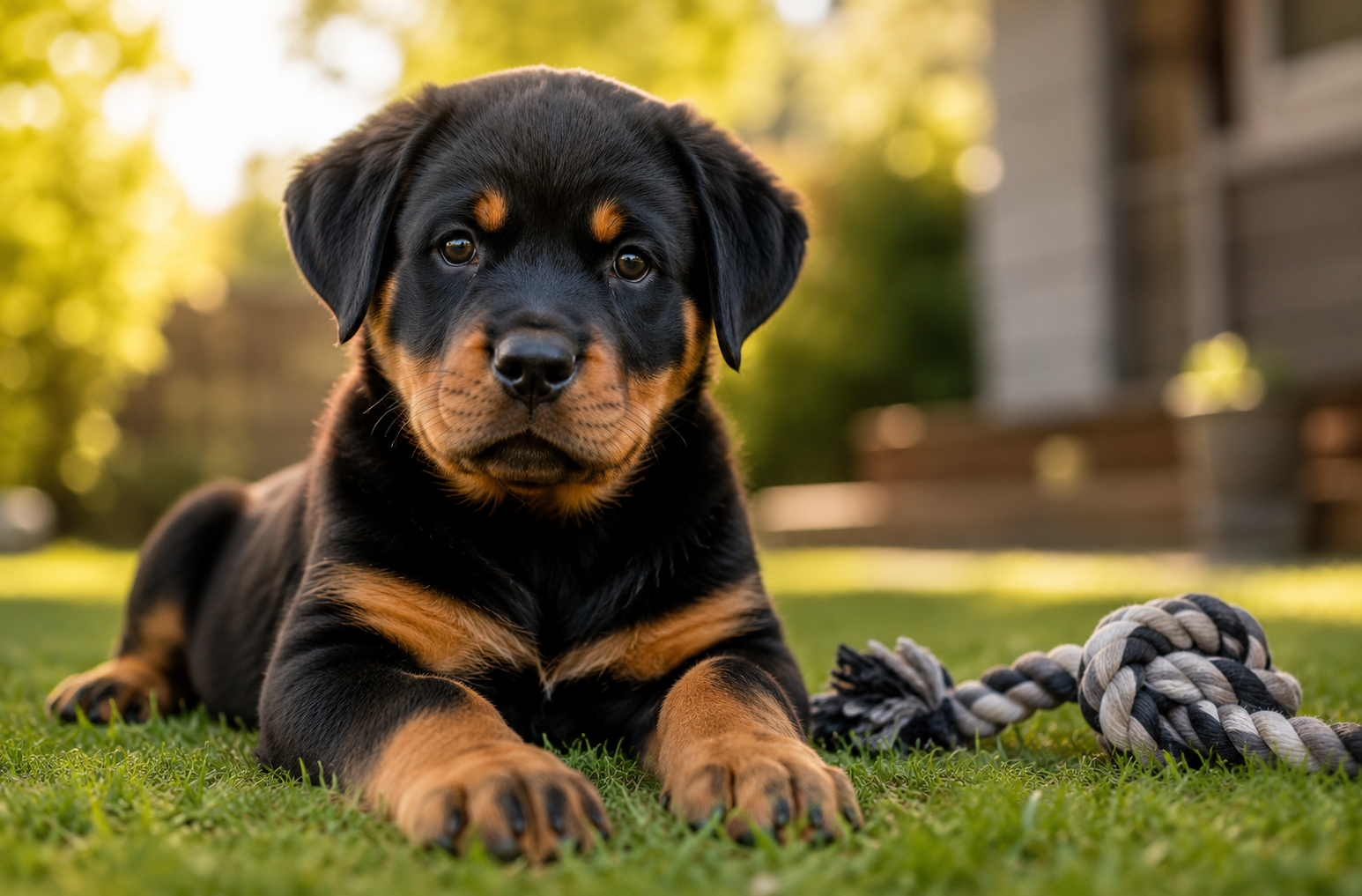
Explore the Rottweiler training roadmap

Start the day your puppy or adult dog arrives. Use short sessions, valuable rewards, sensible management and gradual real-world practice. This pillar guide gives you the complete framework and directs you to focused lessons for commands, obedience, behavior and walking.
Basic commands
Teach sit, down, stay, recall, leave it, drop it, place and release cues using clear markers and rewards.
Learn the essential Rottweiler commandsObedience and reliability
Turn a cue learned in the kitchen into a skill that works around distance, duration and real-world distractions.
Build reliable Rottweiler obedienceImprove behavior
Understand why jumping, barking, chewing, guarding or reactivity happens before choosing a training plan.
Improve common Rottweiler behavior problemsWalking and leash manners
Teach a strong dog to walk on a loose leash while making room for sniffing, safety and individual exercise needs.
Train calm Rottweiler walkingTraining a puppy
Follow age-appropriate lessons for house training, crate skills, recall, bite inhibition, loose-leash walking and alone time.
Start the Rottweiler puppy training guideGuard dog training
Understand alarm dogs, threat dogs and protection dogs — and how to build a safe, controlled family guardian.
Train a Rottweiler guard dog safelySocialization
Help your Rottweiler feel safe and neutral around people, dogs, sounds, handling and new environments.
Use the Rottweiler puppy socialization guideWhy reward-based training works
Dogs repeat behavior that produces a worthwhile outcome. Reward-based training uses that principle deliberately: mark the exact behavior you want, then provide something the learner values. Food is convenient, but reinforcement can also be play, access to sniffing, a door opening, greeting a person or continuing a walk.
Current veterinary behavior guidance recommends reward-based methods for both training and behavior modification. Aversive methods can create fear, avoidance and conflict without teaching the dog what to do instead.
Reward-based does not mean permissive. A complete plan includes:
- Clear and consistent household rules
- Prevention of unsafe rehearsal
- An achievable alternative behavior
- Timely reinforcement
- Gradual increases in difficulty
- Rest, enrichment and appropriate exercise
- Humane loss of an expected opportunity when useful—for example, a door stays closed until the leash is loose
- Professional assessment when fear, pain or aggression may be involved
Read Rottweiler dominance myths if advice about being "alpha" or "pack leader" is getting in the way of a practical plan.
Rottie training tip — Reinforce before you correct
Before asking how to stop a behavior, decide what your Rottweiler should do instead. "Four paws on the floor," "look at me" or "settle on the mat" gives you something observable to teach and reward.
What should you teach first?
Prioritize skills that make everyday life safer and easier:
Name response and check-ins
Say the name once, mark the moment your dog looks toward you and reward. Do not use the name as a reprimand. Voluntary check-ins are the foundation for walking, recall and calm decisions.
Recall
Build a cue that predicts excellent outcomes. Begin indoors, move to a secure yard and then use a long line in suitable open spaces. Never punish a dog after they reach you.
Leave it and drop it
Leave it means disengage before taking an item. Drop it means release something already in the mouth. Train both through reward and exchange rather than grabbing or chasing.
Loose-leash walking
Reward the leash position you want before pulling begins. Walking skill develops through many short, successful repetitions—not by attaching a new tool and expecting it to train the dog.
Settle or place
Teach a mat as a predictable station for visitors, meals and household activity. A settled dog is not simply exhausted; they have learned how to relax within the environment.
Handling and cooperative care
Pair gentle paw, ear, mouth and body handling with rewards. These skills support grooming and veterinary care throughout life.
House, crate and alone-time foundations
Puppies also need routines for elimination, resting and gradual separation. Use the detailed house-training, crate-training and alone-time guides.
Rottweiler training by life stage
Age is a guide, not a deadline. A newly adopted adult may need the same foundation exercises as a puppy, while a confident adolescent may need easier environments before harder cues.
| Life stage | Main training priorities | What to remember |
|---|---|---|
| New puppy at home | Name, toilet routine, sleep, crate comfort, gentle handling, recall games | Keep sessions brief and protect rest |
| Early puppy months | Core cues, safe socialization, bite inhibition, leash foundations, alone-time practice | Exposure should remain positive and below overwhelm |
| Adolescence | Rebuild focus, manage distractions, reinforce calm choices, continue socialization | Reduced reliability is a reason to lower difficulty, not increase force |
| Young adult | Proof cues in varied settings, develop fitness gradually, add structured activities | Match training and exercise to health and maturity |
| Mature adult | Maintain useful skills, introduce new tasks, monitor comfort and motivation | Adults continue learning throughout life |
| Senior | Adapt surfaces, duration, reward placement and physical demands | Veterinary checks matter when behavior or mobility changes |
Do not publish a rigid claim that every Rottweiler completes basic training in two or three months. The mechanics of a cue may be learned quickly, but fluency around distraction requires ongoing practice.
How a Rottweiler learns a cue
1. Create or capture the behavior
Use a lure, hand target, shaping or naturally occurring behavior. Avoid physically pushing the dog into position.
2. Mark the correct moment
A clicker or a short word such as yes identifies the exact instant the behavior succeeded. The marker is a promise that reinforcement follows.
3. Add the verbal cue
Once the behavior is predictable, say the cue immediately before the dog performs it. Adding words too early often creates repeated, unclear commands.
4. Practice in easy contexts
Build several successful repetitions in a quiet place. End while the dog still wants to participate.
5. Generalize gradually
Dogs do not automatically understand that down in the kitchen means the same thing in a park. Change one element at a time: location, distance, duration or distraction.
6. Maintain reinforcement
Move from rewarding every correct response to a thoughtful variable schedule only after the behavior is strong. Continue paying especially difficult or important responses throughout life.
A realistic daily training routine
Training can live inside the day instead of requiring one long formal session.
| Daily moment | 30-second to 5-minute opportunity |
|---|---|
| Before breakfast | Name, hand target, sit or brief mat settle |
| At doors | Leash connection and calm pause |
| First walk | Check-ins and several loose-leash steps |
| Play | Drop, take, pause and recall away from a toy |
| Household activity | Settle on a mat with appropriate enrichment |
| Afternoon outing | Positive exposure and one easy known cue |
| Evening | Cooperative handling, recall game or calm scent search |
| Before bed | Quiet toilet walk with minimal excitement |
Finish before frustration rises. Several successful micro-sessions usually provide better learning than drilling a distracted dog for 30 minutes.
From basic cues to reliable obedience
Reliability depends on three variables:
- Duration: how long the behavior continues
- Distance: how far you are from the dog
- Distraction: what else competes for attention
Increase one at a time. If recall works indoors but fails near another dog, the dog is not being defiant—the environment is currently beyond the trained skill. Use more distance, a long line and a better reinforcement history.
The Rottweiler obedience guide provides a complete proofing plan and explains when to reduce food visibility without removing meaningful reinforcement.
Improve behavior by finding the cause
An unwanted behavior can have different functions. Barking may alert, seek attention, express fear or signal separation distress. Chewing may be exploration, teething, boredom, anxiety or pain. One generic correction cannot safely solve every cause.
Use this framework:
- Describe the exact behavior without labels such as stubborn or dominant.
- Record what happens before and after it.
- Check health, sleep, exercise, enrichment and environmental pressure.
- Prevent rehearsal while you train.
- Teach and reinforce an alternative.
- Increase difficulty only while the dog remains able to learn.
- Get qualified help early for fear, guarding, aggression or panic.
Start with the guide to improving Rottweiler behavior, then use the focused puppy pages for biting, destructive chewing, barking and jumping.
Professional help
Professional help
Contact your veterinarian when behavior changes suddenly, touch causes a new reaction, sleep or appetite changes, or pain may be present. Seek qualified behavior support for biting, resource guarding, severe fear, reactivity that cannot be safely managed or panic during absences. Management and distance protect everyone while a plan is arranged.
Walking is training—and also time to be a dog
A walk can combine loose-leash practice, sniffing, observation, movement and connection. Not every minute needs formal heel position. Teach clear contexts: close walking for a busy section, a release cue for safe sniffing and a long line only in an appropriate open space.
Exercise needs vary with age, health, weather, fitness and the individual dog. Do not use the unsupported five minutes per month of age rule as a medical limit. Build gradually and ask your veterinarian about appropriate impact and duration for a growing large-breed puppy or a dog with orthopedic concerns.
Use the full Rottweiler walking guide for equipment fit, pulling, sniffing, greetings, reactivity and weather safety.
Training equipment: useful tools, not shortcuts
You can teach the foundation with a small kit:
- Comfortable flat collar for identification
- Well-fitted harness suited to the dog and activity
- Fixed-length leash for daily walking
- Long line for secure recall practice in suitable spaces
- Treat pouch with small measured rewards
- Clicker or consistent verbal marker
- Mat and appropriate enrichment toys
A front attachment may help some handler–dog teams manage pulling, but no harness teaches loose-leash walking by itself. Fit matters: straps should not restrict shoulders, rub the armpits or allow escape. Avoid retractable leads in crowded areas and never attach a long line to the neck for high-speed movement.
RottieBuddy may earn a commission from qualifying purchases, at no extra cost to you. Product links never replace professional training or veterinary advice.
Build a simple reward-based training kit.
Compare long lines, harnesses, clickers and treat pouches selected for practical training—not promises of instant control.
Explore the Rottweiler Training Buyer's GuideHow to choose a trainer
Dog training is not uniformly regulated. Look beyond marketing language.
Green flags
- Reward-based methods and a plan the trainer can explain
- Relevant education, continuing development and recognized credentials
- Willingness to let you observe a class
- Clean management and controlled class size
- Collaboration with veterinarians for medical or serious behavior cases
- Individual adaptation instead of breed stereotypes
- No guarantee of a fixed result
Red flags
- Alpha, dominance or pack-leader explanations for every problem
- Shock, prong or choke tools as a standard first approach
- Flooding a frightened dog until they stop reacting
- Taking the dog away without explaining methods
- Blaming the owner or dog rather than adjusting the plan
- Guaranteed cures, instant off-leash control or secret techniques
For formal sport, rally or obedience goals, choose a club that prioritizes welfare as well as performance. Puppy class, life-skills training and competition obedience are different services; select what fits your actual goal.
Training progress checklist
Use an interactive checklist if desired, but store progress locally and do not gate it behind email collection.
- Responds to name in a quiet room
- Offers voluntary check-ins outdoors
- Comes indoors and on a long line
- Waits briefly at doors
- Understands sit, down and release
- Leaves an item before taking it
- Trades and drops safely
- Walks several steps on a loose leash
- Settles on a mat
- Accepts basic handling
- Can rest behind a gate or in a trained safe area
- Recovers after manageable distractions
- Greets without jumping most of the time
- Can disengage from people and dogs at a suitable distance
The checklist measures current contexts, not a permanent "trained/untrained" status.
Choose your next training step.
New puppy owners can follow the complete puppy curriculum; owners working on adult reliability can continue with obedience proofing.
Start Rottweiler Puppy TrainingWhere should you go next?
Basic commands
Teach sit, down, stay, recall, leave it, drop it and place with clear markers and rewards.
Obedience and reliability
Add duration, distance and distraction so cues work outside the kitchen.
Improve behavior
Find the cause of jumping, barking, chewing, pulling or reactivity before choosing a plan.
Walking and leash manners
Loose-leash technique, equipment fit, sniffing, greetings and weather safety.
Frequently asked questions
Are Rottweilers easy to train?
Rottweilers are intelligent and often motivated to work with people, but learning still depends on reinforcement, environment, health and consistency. Strength and confidence make early life skills especially valuable.
When should Rottweiler training start?
Begin immediately with age-appropriate routines, name response, recall games, handling and reinforcement of calm behavior. Adult and rescue Rottweilers can also learn throughout life.
How long should a training session last?
Long enough for several successful repetitions and short enough to finish before focus drops. For a young puppy that may be under a minute; an experienced adult may enjoy longer sessions.
Can I train a Rottweiler without treats?
Food is an efficient reinforcer, especially for new behavior. You can also use toys, play, sniffing, access and praise when they genuinely matter to the dog. Gradually reduce food visibility, not reinforcement itself.
Should I use a prong or shock collar for a strong Rottweiler?
No. Veterinary behavior guidance recommends reward-based training and warns about the welfare and behavior risks of aversive methods. Use humane management and qualified support.
Why does my Rottweiler listen at home but not outside?
Dogs learn in context. The outdoor version needs its own gradual practice with distance, appropriate reinforcement and safety equipment.
Is adolescence a sign that training failed?
No. Increased independence and environmental interest can expose gaps in generalization. Lower the difficulty, prevent unsafe rehearsal and rebuild reinforcement.
Sources and further reading
- American Veterinary Society of Animal Behavior — Position statements and trainer selection
- AVSAB — Humane Dog Training Position Statement
- AVSAB — Dominance Position Statement
- Merck Veterinary Manual — Behavior modification in dogs
- Merck Veterinary Manual — Behavior problems of dogs
- American Animal Hospital Association — 2019 Canine Life Stage Guidelines
- American Veterinary Medical Association — Walking or running with your dog
- American Veterinary Medical Association — Warm-weather pet safety
- American College of Veterinary Surgeons — Canine hip dysplasia
- American College of Veterinary Surgeons — Canine elbow dysplasia
This guide provides general educational information and is not an individual training or behavior plan. Sudden behavior change can have a medical cause. If your Rottweiler shows fear, panic, guarding, aggression or a bite risk, contact your veterinarian and a qualified reward-based behavior professional.
Socialization is not the same as social activity
Socialization helps a dog feel safe and behave appropriately in the world. It is not a competition to meet the most dogs or people. A Rottweiler can learn that strangers, bicycles, children, surfaces and other dogs are neutral without greeting each one.
Use distance, choice and positive outcomes. If the puppy retreats, freezes, stops taking food or cannot disengage, the exposure is too intense. Reduce difficulty rather than forcing contact.
Early socialization is valuable, but it continues throughout life. Pair it with the individual vaccination plan in the Rottweiler puppy vaccination guide.