
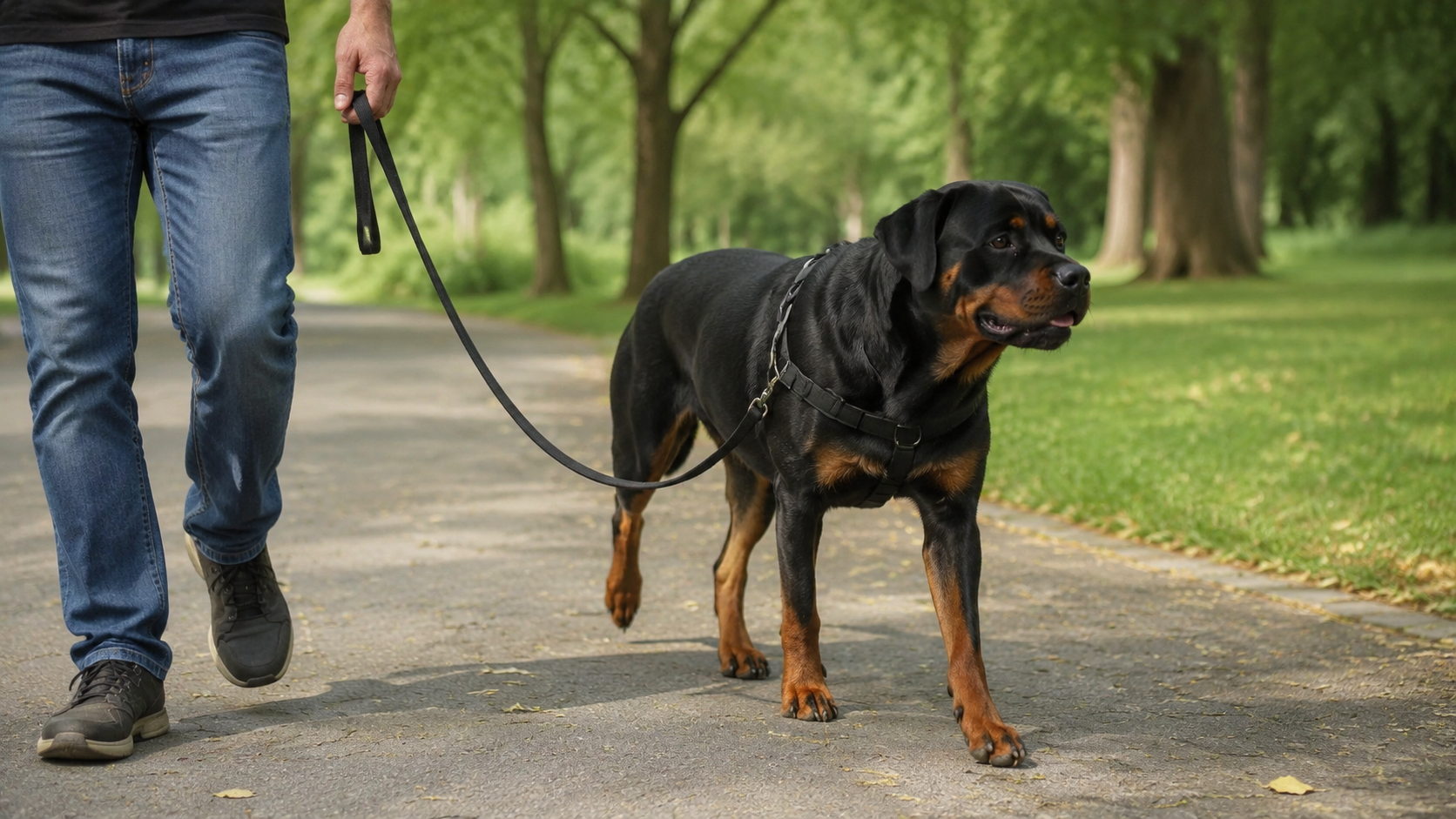
How long should you walk a Rottweiler?
There is no universal minute total for every dog. Consider:
- Age and stage of physical development
- Current fitness and recent activity history
- Body condition
- Hip, elbow, paw, heart or respiratory health
- Temperature, humidity and surface
- Walk intensity and elevation
- Opportunity for self-paced rest and sniffing
- Behavior and recovery after the outing
Healthy adult Rottweilers often enjoy substantial daily activity divided across walks, training, sniffing and play, but online time ranges are only starting points. Increase gradually and ask your veterinarian about a dog who is unfit, overweight, recovering, senior or showing orthopedic signs.
The puppy exercise rule to remove
There is no validated formula of a fixed number of walking minutes per month of age that applies as a medical limit. That popular idea ignores pace, surface, free choice, health and individual development.
Use this safer framework instead:
- Favor short, varied, self-paced outings
- Allow pauses and sniffing
- Avoid repetitive forced running beside a bicycle or human runner
- Avoid repeated high jumps and exhausting fetch drills
- Build distance gradually rather than on a calendar formula
- Stop for lagging, repeated sitting, altered gait or reluctance
- Ask the veterinarian about impact and duration for this large-breed puppy
For skeletal development and warning signs, see the Rottweiler puppy growth guide and hip and elbow guide.
Walking equipment and fit
Harness
A well-fitted Y-shaped harness can be a practical choice. It should allow shoulder movement, sit clear of the armpits, remain stable and prevent backing out. A front attachment can help some handlers manage direction, but it can also alter fit or movement if used poorly. No harness teaches walking by itself.
Collar
Use a comfortable collar for identification. A dog who pulls hard, coughs or lunges should not absorb repeated force through the neck. Discuss equipment with a qualified professional when safety is difficult.
Fixed-length leash
A fixed leash gives predictable feedback. Choose a length that creates useful slack while preserving control for the environment.
Long line
Use a long line in open, suitable spaces for recall and sniffing. Attach it to a harness, keep it away from traffic and other people, and avoid wrapping it around your hand or allowing abrupt high-speed stops.
Retractable leash
The variable tension can conflict with loose-leash criteria, and the thin line and handle present risks in crowded spaces. It may have limited uses in open settings for an experienced handler, but it is not the default tool for training beside roads or people.
Teach loose-leash walking indoors
- Mark and reward your dog for standing near your chosen side.
- Take one step and reward while the leash remains slack.
- Add two or three steps.
- Change direction before the dog reaches the leash end.
- Use a release cue and allow a brief sniff or reset.
- Move to a quiet outdoor area only after the pattern is clear.
Deliver rewards near the seam of your trousers or the desired walking zone. Feeding far ahead can pull the dog forward; feeding high can encourage jumping.
Rottie training tip — Reward the first 30 seconds
Many dogs are most excited at the start. Pause outside the door, reward an early check-in and begin with several easy steps before expecting a long stretch of calm walking.
What to do when the leash tightens
Choose a consistent strategy that fits the space:
- Stop before tension becomes a full-body pull
- Move in a gentle new direction
- Cue a hand target or check-in
- Increase distance from the distraction
- Reward the return of slack
- Release to the desired sniff when appropriate
Do not jerk the leash or drag the dog. If pulling succeeds for one family member and stops movement for another, the behavior receives intermittent reinforcement and becomes harder to change.
Sniffing belongs in the walk
Sniffing provides species-appropriate information and can help lower the pressure of constant formal walking. Individual responses and intensity vary, so avoid treating any exact sniffing-versus-trotting comparison as a rule.
Use clear cues:
- "With me" for a short close-walking section
- "Go sniff" for safe exploration
- Recall or hand target to move on
- "This way" before changing direction
A sniff walk can still include manners. The leash remains safe and the dog moves away from unsafe items, private property and unwilling people or dogs.
Passing people and dogs
Neutrality is a valid social skill. Your Rottweiler does not need to greet every dog.
- Notice the person or dog early.
- Create enough distance for your dog to think and eat.
- Mark a glance followed by disengagement.
- Pass in an arc rather than head-on when space allows.
- Use parked cars, hedges or side streets as visual barriers.
- Decline greetings that do not support training.
On-leash nose-to-nose greetings can add tension, but an absolute ban is not necessary for every social dog. Choose known, appropriate partners and keep leashes loose and interactions brief.
Walking a reactive Rottweiler
Reactivity may involve fear, frustration, pain or learned anticipation. It is not automatically dominance.
- Select low-traffic times and wide routes
- Maintain escape options
- Work below the intensity that triggers barking or lunging
- Reinforce observation and disengagement
- Turn away early rather than correcting an explosion
- Use secure equipment and a backup connection if advised
- Avoid uncontrolled greetings and narrow paths
- Arrange professional help before risk escalates
If the dog cannot take food, respond to an easy cue or recover, increase distance. Desensitization means gradual exposure below overwhelm, not forcing proximity until the dog stops reacting.
Warm-weather walking
Safety first
Rottweilers can become dangerously hot during strenuous activity. Coat color alone does not determine heat risk, but direct sun, humidity, fitness, body condition and health all matter. Read our complete guide to keeping a Rottweiler cool in summer.
- Walk during cooler parts of the day
- Choose shade and shorten intensity
- Bring water and take breaks
- Check surface temperature directly and choose grass or shade when pavement is hot
- Watch for heavy panting, slowing, seeking shade, excessive drooling, weakness, vomiting or confusion
- Stop and seek urgent veterinary help for suspected heat illness
The "five-second hand test" is not a guarantee that pavement is safe. Surface risk changes with material, sun exposure and individual paw condition.
Cold, ice and darkness
- Check paws for ice, injury and road salt
- Rinse and dry paws after treated surfaces
- Use visibility lights or reflective material without depending on them for traffic safety
- Shorten outings if the dog lifts paws, shivers or seeks shelter
- Keep identification current
- Use a fixed leash near roads and low-visibility areas
Signs to stop and reassess
- Repeated sitting or lagging
- Limping or shortened stride
- Scuffing nails or paws
- Reluctance to stand after rest
- Persistent coughing or breathing change
- Excessive panting relative to conditions
- New refusal to use stairs or jump into a vehicle
- Stiffness later that day or the next morning
Professional help
Professional help
Contact your veterinarian for sudden exercise intolerance, lameness, pain, collapse, coughing, breathing difficulty or gait change. Seek a qualified reward-based trainer for pulling, fear or reactivity that you cannot manage safely. Equipment cannot diagnose pain or replace a behavior plan.
RottieBuddy may earn a commission from qualifying purchases, at no extra cost to you. Product links never replace professional training or veterinary advice.
Choose walking equipment for fit, environment and training—not instant control.
Compare harnesses and long lines, then check fit and practice in an easy location before a busy walk.
Compare Rottweiler Training HarnessesContinue your training plan
Frequently asked questions
How long should I walk a Rottweiler puppy?
There is no validated universal minute formula. Use short, varied, self-paced outings, build gradually and ask your veterinarian about individual joint and growth considerations.
How do I stop my Rottweiler pulling?
Begin in a low-distraction place, reward slack leash frequently, prevent forward progress during tension and increase difficulty gradually.
Is a front-clip harness best for a Rottweiler?
It can help some teams manage direction, but fit and movement matter and it does not teach the skill. Choose equipment with professional help if needed.
How much exercise does an adult Rottweiler need?
Needs vary with health, fitness, body condition, age, weather and activity type. Divide appropriate activity across movement, sniffing, play and training rather than chasing one universal number.
Should my Rottweiler greet dogs on leash?
Not every dog. Neutral passing is valuable. Allow only appropriate, consensual greetings where both dogs are comfortable and the leashes can remain loose.
Can my Rottweiler run with me?
Ask your veterinarian before starting, especially for a growing, unconditioned or orthopedically vulnerable dog. Build pace and distance progressively and avoid heat.
Sources and further reading
- American Animal Hospital Association — 2019 Canine Life Stage Guidelines
- American Veterinary Medical Association — Walking or running with your dog
- American Veterinary Medical Association — Warm-weather pet safety
- American College of Veterinary Surgeons — Canine hip dysplasia
- American College of Veterinary Surgeons — Canine elbow dysplasia
This guide provides general educational information and is not an individual training or behavior plan. Sudden behavior change can have a medical cause. If your Rottweiler shows fear, panic, guarding, aggression or a bite risk, contact your veterinarian and a qualified reward-based behavior professional.
This guide provides general educational information and is not an individual training or behavior plan. Sudden behavior change can have a medical cause. If your Rottweiler shows fear, panic, guarding, aggression or a bite risk, contact your veterinarian and a qualified reward-based behavior professional.