Breeder foundations
Before pickup, useful early experiences include gentle handling, household life, litter interaction and safe novelty.
- Human handling
- Everyday sounds
- Different surfaces

A well-socialized Rottweiler does not need to greet everyone. The real goal is a puppy that can notice people, dogs, sounds, places and everyday life without becoming overwhelmed. Use this guide to build calm confidence through short, positive and age-appropriate experiences.
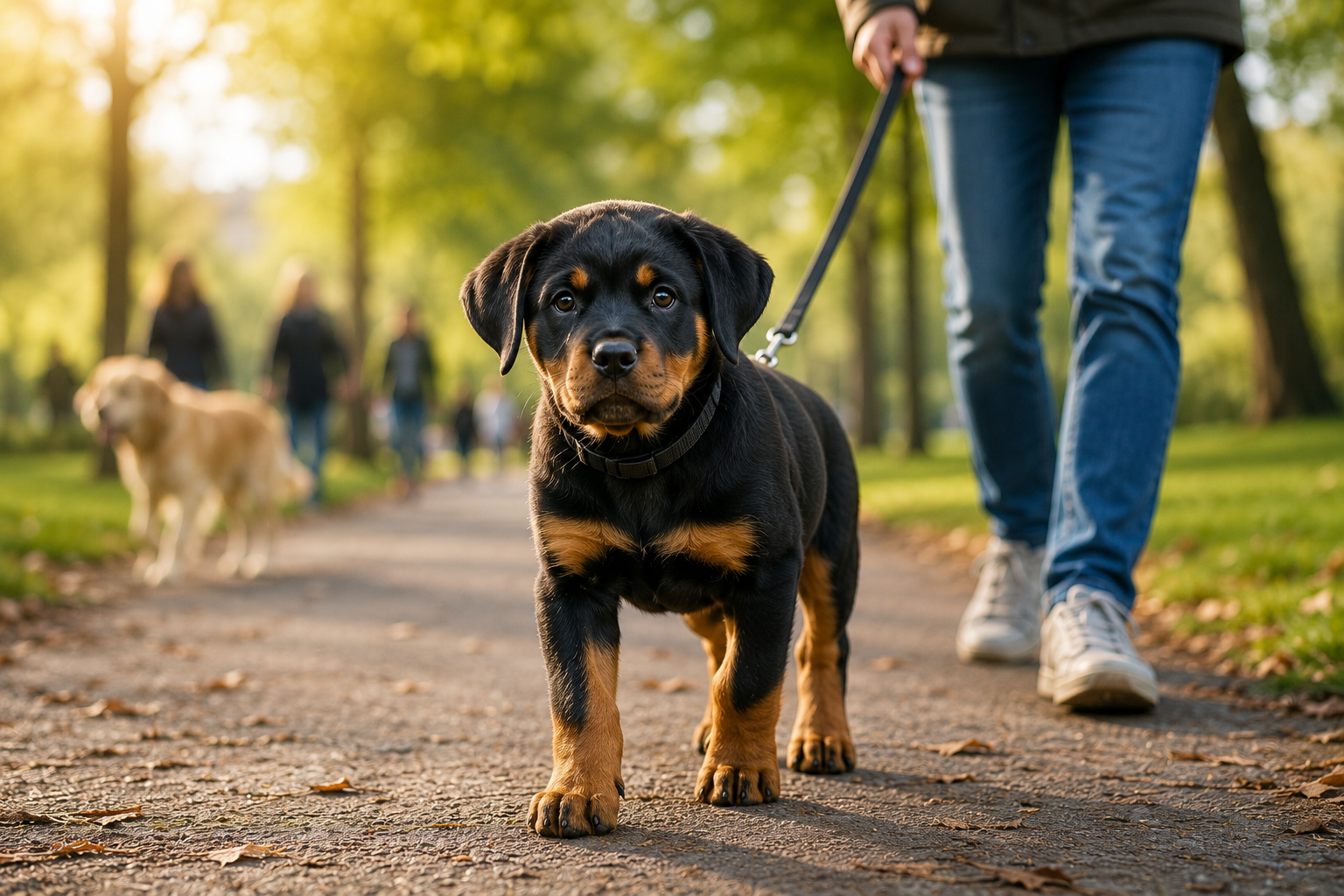
The early puppy period is especially important, but socialization does not expire at 16 weeks. Keep building calm, positive experiences through adolescence and adulthood.
Before pickup, useful early experiences include gentle handling, household life, litter interaction and safe novelty.
Keep experiences small and positive while your puppy also learns a new home, sleep routine, potty routine and relationship with you.
Continue controlled novelty, suitable puppy classes and calm exposure to places, dogs and everyday movement.
Your puppy is bigger and more independent. Keep social skills paired with obedience and calm behavior around distractions.
Continue exposing your adolescent Rottweiler to normal life while reinforcing neutrality, impulse control and recovery from surprises.
The same four-step method works for a person in a hat, a passing bus, a vacuum cleaner, a vet table or another dog. You control distance and intensity; your puppy controls whether to move closer.
Let your puppy see, hear or smell the new thing from far enough away that they can still think, eat and respond to you.
Use food, play, praise or simply comfortable distance so the new experience predicts something positive rather than pressure.
If your puppy approaches, great. If they prefer to watch, that also counts. Do not lure a worried puppy right into the thing they fear.
Short successful exposures build confidence better than staying until your puppy becomes tired, overexcited or frightened.
This is not a race to tick every box once. Repeat easy experiences, vary locations and keep intensity low enough that your puppy stays comfortable.
Each situation has its own body-language and safety considerations. Use these focused guides where you need more detail.
Teach calm behavior around strangers, visitors, unusual clothing and everyday human movement without requiring greetings.
Socializing with people →Supervise both sides, protect the puppy’s space and teach children how to interact without grabbing, hugging or chasing.
Rottweilers & children →Choose suitable dogs, interrupt rough play early and teach your puppy that seeing another dog does not always mean interaction.
Socializing with dogs →Build comfort with household and outdoor noises gradually, starting softer or farther away than real life.
Sound socialization →Start with a stationary vehicle, then brief journeys, so the car predicts calm travel rather than nausea or stress.
Car confidence →Practice handling, surfaces, waiting and short positive clinic visits before every trip involves an injection or procedure.
Vet confidence →Socialization works best below the point where your puppy feels trapped or overwhelmed. Watch the whole body and how quickly your puppy recovers, not just the tail.
Keep the session short even when everything is going well.
Add distance, lower intensity and allow time to observe.
Create distance. Do not force the puppy to “get over it.”
Flooding can teach the puppy that the trigger predicts loss of control. Add distance and let curiosity return.
Constant greetings can create frustration and overexcitement. Practice calmly passing dogs without interaction.
Short repeated experiences are easier to process than a packed day full of new people, places and sounds.
A skill learned at home does not automatically transfer to a street, café, vet clinic or busy parking lot.
Sleep matters. Puppies need downtime after novelty, especially during the first weeks in a new home.
Adolescence can change confidence and behavior. Keep positive exposure and neutrality training going.
You do not need a daily adventure. Fit socialization into normal life and finish before the puppy becomes tired or over-aroused.
Paws, ears, brush or mouth — one tiny skill at a time.
Observe from comfortable distance; greeting is optional.
Traffic, a quiet shop entrance or a new surface underfoot.
Not every ride needs a destination.
Give the nervous system time to process what your puppy just experienced.
Socialization works best alongside predictable routines and age-appropriate training rather than as a separate project.
See how socialization fits alongside sleep, feeding, potty training, biting, crate work and short training sessions.
Open 8–12 week guide →Build name recognition, recall, leash foundations and calm behavior around distractions.
Training hub →Check harness, leash, travel and reward essentials before socialization outings.
Puppy essentials →Social learning begins before your puppy comes home and should continue immediately with safe, positive experiences. The early puppy period is especially valuable, but socialization continues through adolescence and adulthood.
No. Calm neutrality is an important social skill. Your puppy can notice a person or dog, remain relaxed and move on with you. Controlled greetings are useful, but they should not become an expectation every time.
Young puppies still need social learning while vaccination protection is developing. Ask your veterinarian about local disease risk and use lower-risk options such as being carried, observing from a clean safe area, calm car rides and meeting known healthy vaccinated dogs.
Increase distance, avoid forcing interaction and let your puppy observe while pairing the experience with something positive. If fear is intense, persistent or getting worse, seek help from a qualified reward-based trainer or veterinary behavior professional.
Crowded, uncontrolled dog parks are not necessary for puppy socialization and can create overwhelming experiences. Known suitable dogs, well-managed puppy classes and calm observation usually give you much more control over the learning experience.
There is no useful magic number. One or two short successful exposures can be more valuable than a long day full of novelty. Watch your puppy’s comfort level and allow plenty of sleep and recovery afterward.
Keep working. Early experience matters, but learning does not stop at a deadline. Use controlled positive exposure, go at the dog’s pace and get professional help if fear or reactivity is making progress difficult.