Puppy biting · practical help

How to Stop Rottweiler Puppy Biting & Mouthing

Rottweiler puppy teeth are tiny; the jaws behind them are not. Mouthing is normal puppy behavior, but hands, sleeves and ankles do not need to become chew toys. First identify why the biting is happening, then use a calm response that teaches your puppy what to bite instead.

6-step response for bites during playPlay vs warning signs clearly separatedNo alpha-roll advice — teach the safer choice
🦷TeethingA strong need to chew
🎮PlayMovement triggers mouthing
💤OvertiredEvening shark mode
🛡️SafetyKnow the red flags
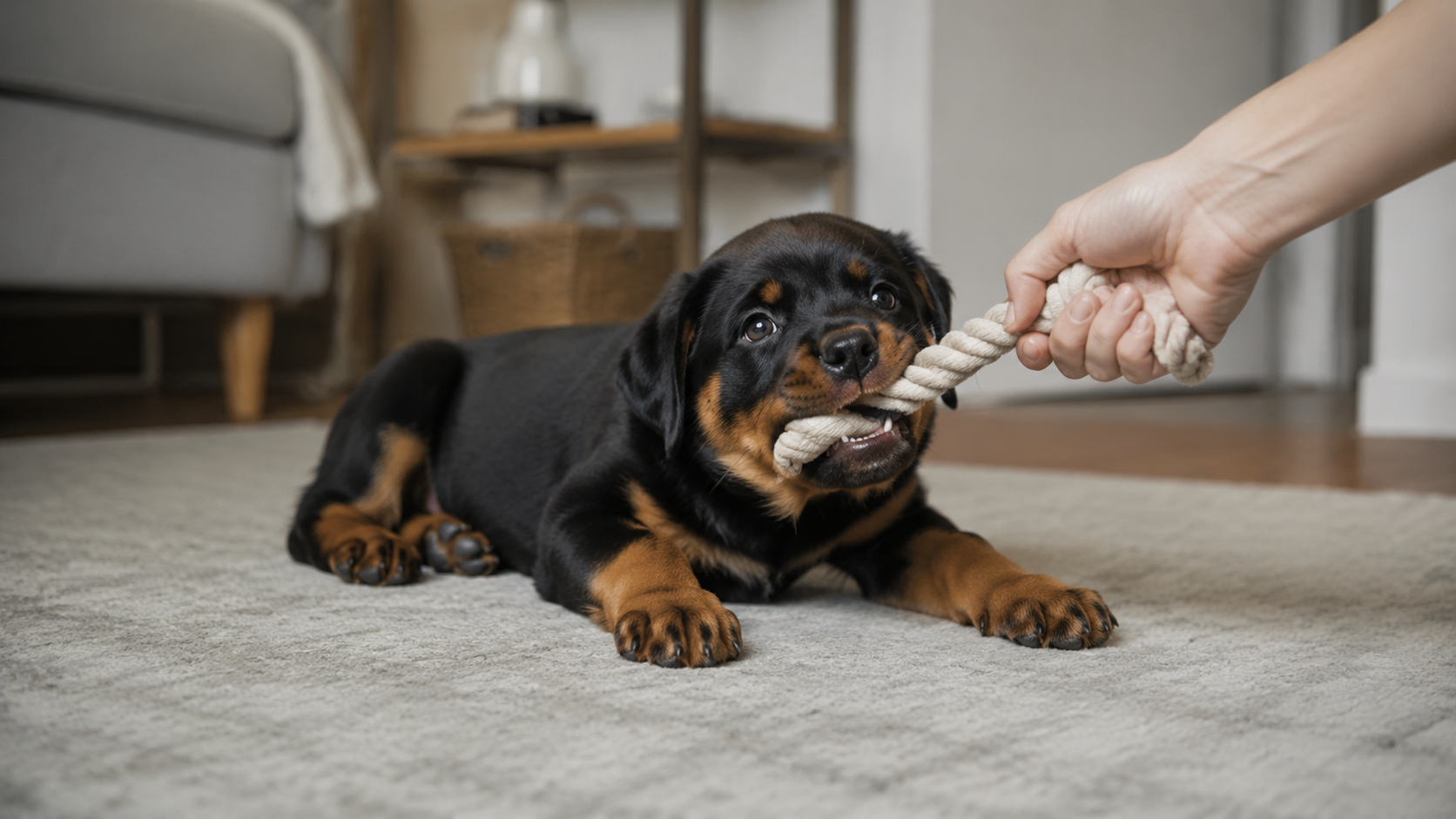
Rottweiler puppy choosing a rope tug toy instead of biting a person's hand
The goal is not “never use your mouth”Teach what teeth can touch, how hard, and when play needs to stop.
The simple ruleTeeth on skin make play pause. Teeth on the right toy make good things continue.
StillStop fast hand movement.
PauseBriefly remove attention.
RedirectReturn with a legal target.
Biting pattern finder

When does your Rottweiler puppy bite most?

The same teeth can have very different causes. Choose the situation that looks most familiar to see what may be driving it and what to change first.

Likely explanation

Normal play mouthing + rising arousal

Hands and moving clothing are exciting targets. The faster people react, pull away or wrestle, the more fun the game can become.

  • Use long toys between puppy teeth and hands
  • Pause before play becomes frantic
  • Reward carrying and chewing the toy
Change this first

Lower arousal before teaching more

Shorter play with predictable pauses gives your puppy more chances to succeed before self-control disappears.

Try: 20–30 seconds of toy play → pause → four paws down → reward → resume.
Handling or resource-related biting needs more caution. Stiff posture, guarding, pain, repeated hard bites or escalating threats are not a situation to “train through” by force. Create safety and get individual professional advice.
When teeth touch skin

Use this calm 6-step response

You do not need to squeal, wrestle the puppy off or hold the muzzle shut. The consequence is simple: biting people makes interaction pause; safer choices make interaction continue.

Consistency beats intensity. A boring, repeatable response used by everyone in the home is more useful than a dramatic correction used occasionally.
01

Become still

Stop waving, pulling or jerking the bitten hand or clothing away. Fast movement can trigger more grabbing.

02

Pause play and attention

Calmly remove access to the interaction for a brief moment. No lecture is required.

03

Create space if your puppy keeps pursuing

Step behind a gate, use a pen or move out of reach instead of grabbing the collar during high arousal.

04

Return with an appropriate toy

When arousal drops, offer a long tug, rubber puppy toy or another safe target for the mouth.

05

Reward the calm behavior between bites

Pay four paws on the floor, carrying a toy, lying down and choosing to disengage.

06

If it starts again immediately, check basic needs

Potty, water and a quiet rest period may solve more than another training repetition.

More consistent with puppy play

Mouthy, excited — but recoverable

Context still matters, but these patterns are commonly seen in overexcited puppy play.

  • Loose, wiggly bodyMovement remains bouncy rather than frozen.
  • Grabs moving sleeves or handsEspecially during play or chase-like movement.
  • Can redirect after a pauseToy, food or distance helps the puppy reset.
  • Intensity tracks excitement / tirednessMore common when arousal is already high.
  • Recovers normallyThe puppy can return to relaxed interaction.
Prompt individual assessment

Threatening, painful or escalating

Do not dismiss these patterns as “just puppy biting.” Create safety and get qualified help.

  • !
    Stiff or frozen postureEspecially with hard staring, lip lifting or low threatening growls.
  • !
    Guarding food, toys or stolen objectsDo not forcibly remove the item.
  • !
    Biting during touch or restraintPain or fear may be involved.
  • !
    Punctures or rapidly increasing forceSeverity matters even in a young puppy.
  • !
    Continues pursuing after disengagementEspecially when the person is trying to leave.
Find the pattern

Biting gets easier to solve when you can predict it

Write down when the biting happens for two or three days. Often the “random” behavior has a very repeatable trigger: certain play, a long awake period, movement, frustration or specific handling.

During play
Likely rising arousal

Play gets faster and less thoughtful.

Try

Shorter sessions, long toy, frequent calm pauses.

Evening
Often fatigue + stimulation

Self-control drops late in the day.

Try

Potty, calm enrichment, less activity, nap / bed.

Walking past
Movement triggers chase / grab

Ankles and trousers become toys.

Try

Stop movement, redirect before the grab, manage with gates.

Training
Frustration or session too hard

Puppy loses ability to think.

Try

Make task easier, shorten session, reinforce calm.

Object removal
Conflict / guarding risk

Chasing and grabbing can make this worse.

Try

Manage access and teach voluntary trades.

Mini biting diary

Track just three things

TimeWhen does it usually happen?
TriggerWhat happened immediately before?
IntensityLight mouthing, hard grabbing or injury?
The training lesson

Bite inhibition is the deeper skill

This page helps you troubleshoot the behavior and manage bites in real life. The separate Bite Inhibition training guide gives you the structured training sequence for teaching softer mouth use, legal targets and calm interaction.

Behavior page

Why is the biting happening and what do I do right now?

Bite-inhibition training page

How do I systematically teach better mouth control over time?

Both work together

Management prevents repeated mistakes while training builds the replacement skill.

Teething

Give the mouth a better target

During teething, chewing is a biological need. Redirection becomes much easier if appropriate toys are already within reach instead of hidden in another room.

Long toyKeeps hands farther from teeth during play.
Rubber chewUseful for independent chewing and food enrichment.
Rotate toysA few options feel newer when they are not always available.
  • Choose toys appropriate to the puppy’s size and chewing style.
  • Inspect toys regularly and remove damaged pieces.
  • Supervise unfamiliar chew products.
  • Separate destructive chewing of objects from biting people.
Prevent before redirecting

Set the room up for success

The best redirection happens before the puppy has already rehearsed grabbing skin ten times. Put management where the behavior happens.

Baby gateCreates calm separation without a collar battle.
PlaypenUseful for decompression and supervised downtime.
Toy basketKeep legal targets in the actual biting zones.
  • Avoid rough games that teach hands are toys.
  • Wear practical clothes during the learning stage.
  • Keep training sessions short enough for success.
  • Reward calm behavior before teeth appear.
Evening shark mode

When biting gets worse at the end of the day

Accumulated fatigue and household activity can turn an ordinary puppy into a little crocodile. More intense exercise is not automatically the answer.

1. Potty
Take a quiet toilet break

Rule out the most immediate physical need.

2. Reset
Stop rough play and chasing

Do not keep feeding the arousal loop.

3. Mouth
Offer a calm legal chew

Food enrichment or a suitable chew can help shift the activity level down.

4. Room
Reduce household stimulation

Less movement, noise and interaction can make settling easier.

5. Sleep
Guide toward nap or bedtime

Young puppies need a large amount of sleep; rest is part of the behavior plan.

Puppy biting children

Management comes before training

A child should not be responsible for implementing a bite-training plan while a mouthy puppy is already overexcited. Adults manage the puppy; the child gets space and safety.

🚪

Use gates & pens

Separate during running, exciting play, meals and puppy rest rather than waiting for biting to start.

🧒

Teach child boundaries too

No hugging, climbing, chasing, cornering or taking items directly from the puppy.

🦴

Use appropriate toys

Do not encourage wrestling with hands, sleeves or clothing.

💤

Protect puppy rest

A sleeping or retreating puppy should be left alone.

Get prompt professional help if bites puncture skin, target the face, occur around food or objects, follow handling, involve stiff threatening body language, escalate in force or make anyone in the household afraid.
Do more of this

Reward the behavior between the bites

The fastest time to teach calm behavior is before your puppy is already hanging from a sleeve.

Reward carrying a toy

Make legal mouth behavior valuable.

Reward four paws down

Useful before exciting greetings and play.

Reward lying nearby

Calmness should earn reinforcement too.

Reinforce voluntary disengagement

Looking away and taking a pause are valuable skills.

Do not do this

Avoid physical confrontation

Harsh responses may increase fear or arousal and do not teach your puppy what behavior should replace biting.

×
No alpha rolls, scruffing or pinning

Do not physically overpower the puppy.

×
Do not hold the muzzle shut

This can create handling conflict.

×
No hitting, face shouting or shock collars

Teach and manage rather than intimidate.

×
Do not punish growling

Growling is warning information; address the underlying concern.

Teach calm behavior too

Bite inhibition gets easier when your puppy has other skills

“Stop biting” is not one isolated lesson. A puppy with useful ways to settle, disengage and interact has more alternatives available during exciting moments.

🪑

Sit

A simple behavior to reinforce before greetings and toy play.

Teach sit →
🧘

Down & settle

Build a slower behavior that competes with frantic movement and grabbing.

Teach down →
👂

Name recognition

Teach your puppy that orienting toward you is rewarding before distractions get harder.

Name recognition →
🏠

Calm alone time

Short comfortable downtime helps a puppy learn to switch off without constant interaction.

Alone-time guide →
Editorial basis

Sources & further reading

This guide follows humane, reward-based training principles and general bite-safety guidance from the following veterinary and animal-behavior organizations.

Rottweiler puppy biting FAQ

Questions owners ask most

When do Rottweiler puppies stop biting?

Mouthing often decreases as teething ends, impulse control improves and training becomes more consistent, but there is no automatic age when all biting disappears. Prevention and teaching should begin immediately.

Should I yelp when my Rottweiler puppy bites?

Some puppies pause when they hear a yelp, but others become more excited. If vocal reactions increase arousal, become still and calmly pause interaction instead. You do not need to imitate a littermate.

Why does my puppy bite more in the evening?

Accumulated fatigue, household activity, teething and excitement can reduce self-control. Try a toilet break, less stimulation, a calm legal chew and sleep rather than automatically adding harder exercise.

Is tug play making my Rottweiler puppy aggressive?

Structured tug does not automatically create aggression. Use a suitable toy, keep teeth away from hands, teach start and release cues and pause the game before arousal becomes unmanageable.

Does puppy biting mean my Rottweiler is aggressive?

No. Puppy mouthing is common and does not automatically indicate aggression. Context, body language, force, triggers and recovery matter. Stiff threats, guarding, handling-related bites or escalating injury deserve individual assessment.

Should I punish growling when my puppy bites?

No. Growling is warning information. Punishing the warning can suppress communication without resolving fear, pain or conflict. Create distance, identify the trigger and seek qualified help when safety is a concern.

When should I get professional help for puppy biting?

Get prompt individual help for punctures, guarding, handling-related bites, stiff threatening body language, escalating force, sudden irritability, suspected pain or any situation involving children or vulnerable people where safety is uncertain.

This guide is general educational information, not a diagnosis or individual behavior plan. Sudden irritability, touch sensitivity or behavior change can have a medical cause. Contact your veterinarian for possible pain or illness, and use an appropriately qualified reward-based behavior professional for serious or escalating bite concerns. If a bite breaks human skin, wash the wound thoroughly and seek appropriate medical advice, particularly for deep wounds, bites to the hand or face, or signs of infection.

Next step

Manage today’s bites. Train tomorrow’s mouth control.

Use the behavior plan on this page in the moment, then build the long-term skill with bite inhibition, calm training and enough puppy sleep.