
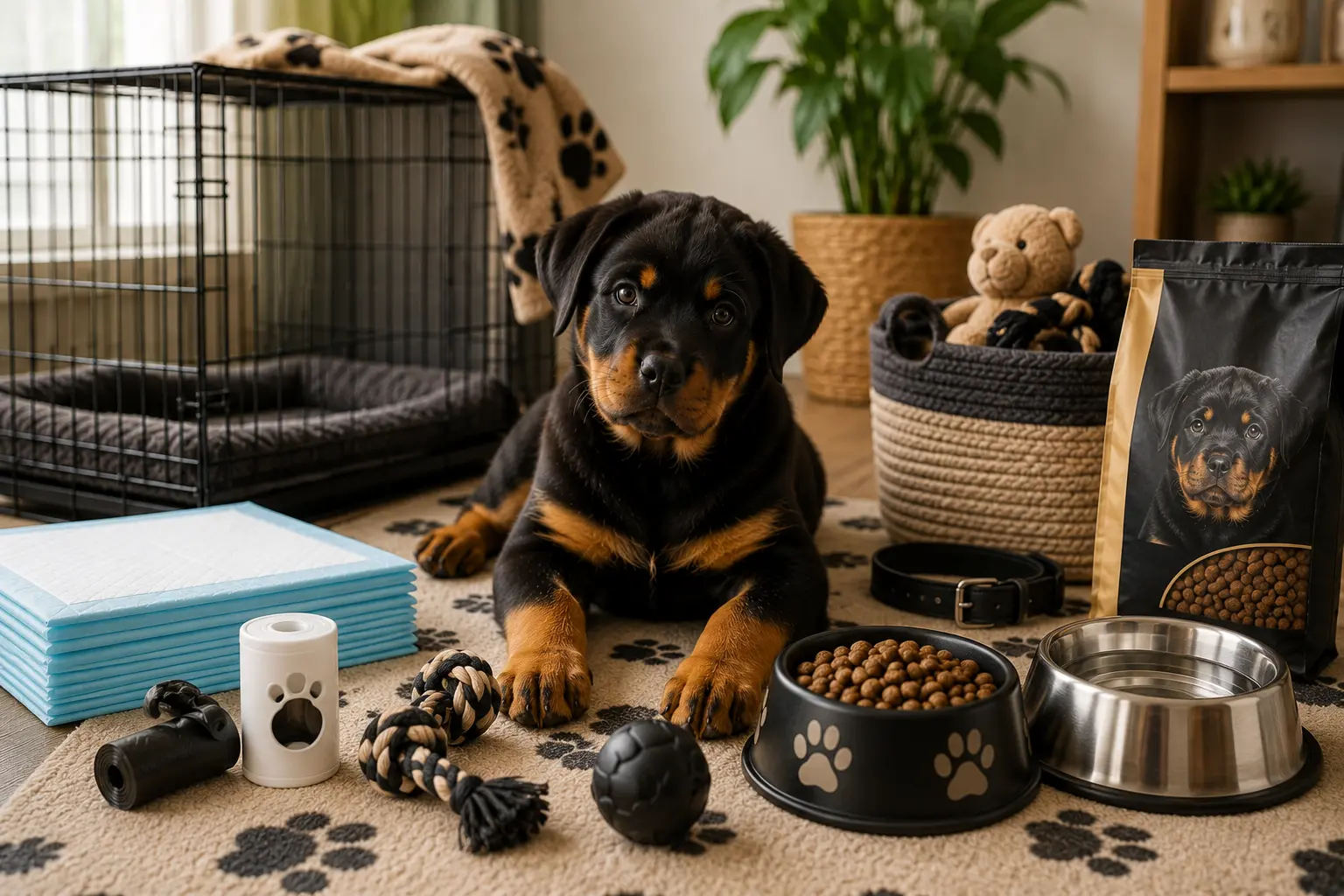
Crate Training a Rottweiler Puppy
Rottweilers are intelligent, people-focused dogs, but a young puppy still needs time to learn that being behind a crate door is safe. Start with voluntary exploration, food and very short periods with the door closed. Increase time only while your puppy remains comfortable.
Crate training works especially well alongside Rottweiler puppy house training, because it helps you build a predictable rhythm around sleep, supervision and potty breaks.
On this page
Choose the Right Crate for a Rottweiler Puppy
Your puppy should be able to stand up, turn around and lie down comfortably. Because a Rottweiler grows quickly, an adult-size crate with an adjustable divider is often the most practical choice. The divider prevents a young puppy from having far more space than needed while still letting the crate grow with them.
| Crate feature | Why it matters for a Rottweiler puppy |
|---|---|
| Correct size | Enough room to stand, turn and stretch out without creating a huge unused toilet area. |
| Adjustable divider | Lets you resize the sleeping area as your fast-growing puppy gets bigger. |
| Secure construction | A growing Rottweiler is strong, so doors, latches and panels should feel sturdy. |
| Removable washable tray | Makes the occasional puppy accident much easier to clean. |
| Safe bedding | Comfort can encourage relaxation, provided your puppy does not shred or swallow the material. |
How to Crate Train a Rottweiler Puppy Step by Step
Do not aim for a long closed-door session on day one. Build the skill in small pieces and move forward only when your puppy is relaxed at the current step.
Let your puppy investigate
Leave the crate door open. Allow sniffing and voluntary entry without pushing, pulling or closing the door.
Create an easy win
Toss a treat just inside the entrance. Repeat until your puppy walks in confidently, then place treats slightly farther inside.
Feed around the crate
Serve meals near the entrance, then gradually move the bowl farther inside as your puppy becomes comfortable.
Close the door for seconds
When your puppy is calm inside, close the door briefly. Stay nearby and open it again before your puppy becomes worried.
Build calm duration
Increase the closed-door time gradually. Reward calm behavior and keep early sessions short enough to stay successful.
Add distance
Take one or two steps away, return, then release your puppy while they are settled. Slowly build up to leaving the room briefly.
Practice real-life routines
Use the crate for short naps and calm rest while you are still at home, so the crate does not only predict that you are leaving.
Make the Crate a Positive Place
Your puppy should build a history of good experiences in and around the crate. Use it for calm moments rather than as a response to unwanted behavior.
What If My Rottweiler Puppy Cries in the Crate?
Crying does not automatically mean your puppy is being stubborn. Before deciding what to do, consider why the puppy may be vocalizing.
| Possible reason | What to do |
|---|---|
| Needs to go potty | Take your puppy outside calmly, allow a toilet opportunity, then return to the nighttime routine. |
| Training progressed too fast | Shorten the next session and rebuild duration more gradually. |
| Wants attention | Avoid turning every small sound into playtime; reinforce moments of calm. |
| Overtired or overstimulated | Lower the energy around bedtime and create a more predictable wind-down routine. |
| Genuine distress | Stop increasing difficulty and return to easier, positive crate sessions. |
Crate Training a Rottweiler Puppy at Night
For the first nights, keeping the crate close to your bed can make the transition easier and helps you notice when your puppy wakes because they need to go outside. Keep nighttime toilet trips simple: outside, potty, quiet praise and back to bed.
Calm activity, final potty opportunity and no exciting play immediately before sleep.
Settle the puppy in the crate with the same quiet routine each night.
If a toilet break is likely, go straight outside and keep the trip boring.
Take your puppy outside promptly after waking, then begin the normal day.
Need help with the toilet routine too? Read How to House Train a Rottweiler Puppy.
How Long Can a Rottweiler Puppy Stay in a Crate?
There is no single crate-time rule that fits every puppy. Age, toilet needs, previous training, sleep, activity level and how comfortable the puppy is with the crate all matter. The crate should support a healthy routine — not replace exercise, play, social contact, training and opportunities to explore.
If your goal is to prepare your puppy to stay home without you, combine crate work with gradual alone-time training. They are related skills, but they are not the same thing.
Common Rottweiler Puppy Crate-Training Mistakes
Frequently Asked Questions About Rottweiler Crate Training
Should a Rottweiler puppy sleep in a crate?
A positively introduced crate can provide a predictable sleeping area. Whether you continue using it long term depends on your household routine and your dog’s comfort.
Should I put food in my Rottweiler puppy’s crate?
Feeding meals in or near the crate can help build a positive association, especially during the early training stages.
Why does my Rottweiler puppy cry in the crate at night?
Your puppy may need to go potty, may be unsettled by the new environment, or the crate-training process may have moved too quickly. Look at the context instead of treating every sound as disobedience.
Can crate training prevent separation anxiety?
Crate training and learning to be alone are different skills. A puppy should also practice short, gradual periods without you in ways that remain comfortable.
What size crate does a Rottweiler puppy need?
The crate should allow your puppy to stand, turn around and lie down comfortably. An adult-size crate with an adjustable divider can be practical for a fast-growing Rottweiler puppy.
More Rottweiler Puppy Training Guides
Bringing home a Rottweiler puppy?
Start prepared with one practical checklist for supplies, your first days at home, training and nutrition.
Get the free puppy checklist →