Back to Rottweiler Puppy Nutrition

What Is the Best Food for a Rottweiler Puppy?

The best food for a Rottweiler puppy is not automatically the bag with the most protein, the longest ingredient list or the boldest marketing claim. It is a complete and balanced diet designed for growth including large-size dogs, made by a company that can explain who formulates the food, how it is tested and how its quality is controlled.

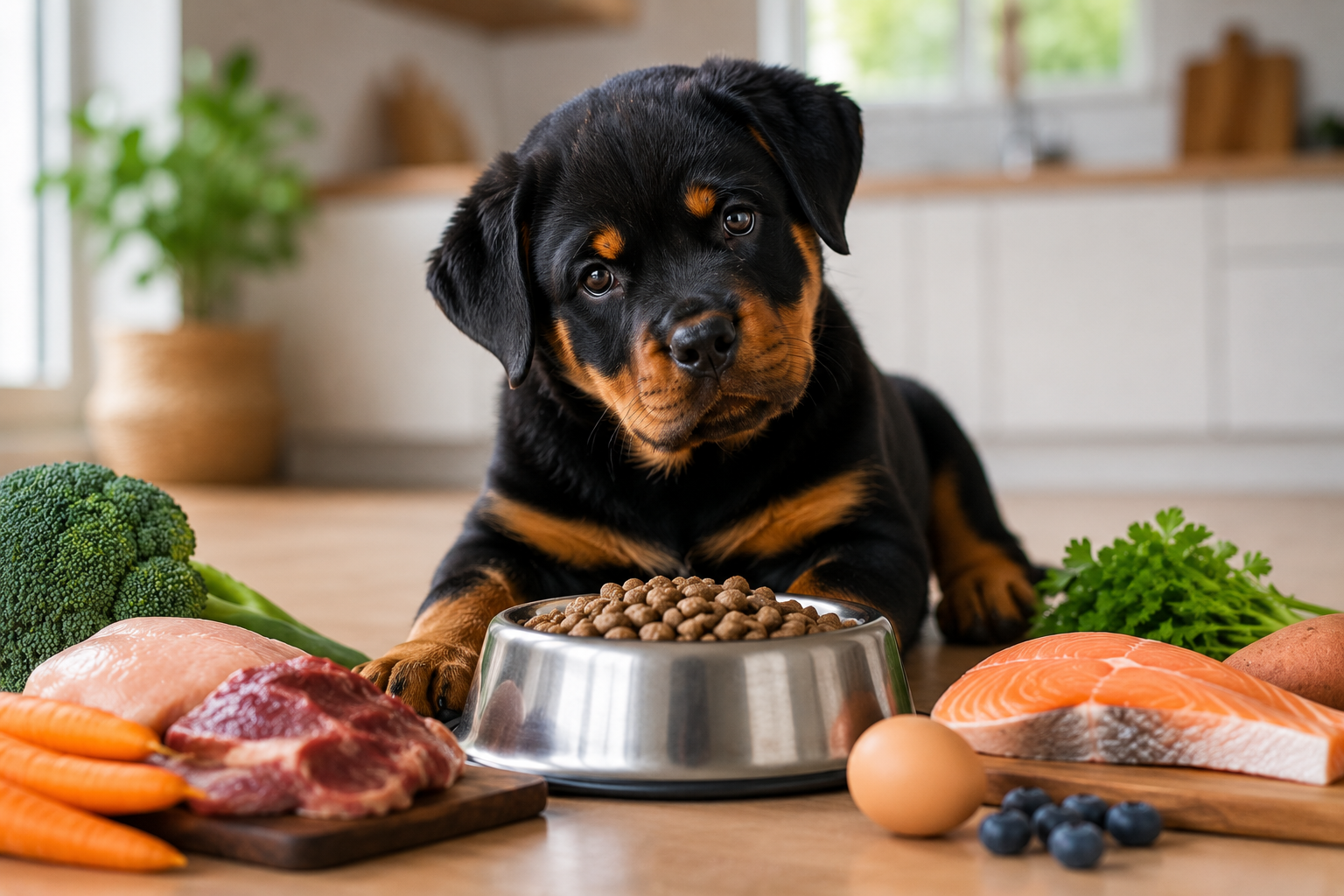
Rottweiler puppy beside balanced dry and wet puppy food options in a bright kitchen

What Is the Best Food for a Rottweiler Puppy?

Rottweilers grow quickly and mature more slowly than small dogs. During this stage, excessive calories and poorly balanced minerals can be just as unhelpful as too little nutrition. Your goal is controlled, steady growth and a lean puppy—not maximum size as fast as possible.

Quick answer: the five-point puppy food check

Before buying, check that the food:

  1. Is complete and balanced for growth
  2. Explicitly includes growth of large-size dogs (70 lb / 32 kg or more as an adult)
  3. Provides calorie and feeding information you can understand
  4. Comes from a manufacturer with qualified nutrition expertise and clear quality-control answers
  5. Works for your individual puppy's body condition, digestion, health and budget

The nutritional adequacy statement matters more than phrases such as "premium," "natural," "holistic" or "human-grade."

Read this statement before the ingredient list

On food sold in the United States, find the AAFCO nutritional adequacy statement. For a Rottweiler puppy, look for wording that confirms the diet is appropriate for growth and includes the growth of large-size dogs.

Be cautious if the statement says:

  • For adult maintenance — not a complete main diet for a growing puppy
  • Except for growth of large-size dogs — not appropriate for a Rottweiler puppy
  • For intermittent or supplemental feeding only — not a complete everyday diet

"All life stages" is not automatically better. It still needs to include large-size growth, and the calorie density must suit your puppy.

What matters in a large-breed puppy formula?

Controlled energy

More calories can produce faster weight gain, but faster is not the goal. Feed enough to maintain a lean condition and adjust the amount of food as your puppy grows.

Balanced calcium and phosphorus

Growing large-breed puppies do not need calcium added "for strong bones" when their main food is complete and balanced. Excess mineral supplementation can disturb the balance. Read our focused guide to calcium for Rottweiler puppies.

Adequate, digestible protein

Puppies need protein and essential amino acids for growth. A percentage on the front of a bag cannot tell you everything about protein quality, digestibility or the food's total nutrient balance. Our Rottweiler puppy protein guide explains how to compare labels.

Essential fatty acids

Fat supplies energy and essential fatty acids. DHA and other omega-3 fatty acids have roles during growth, but adding oil to a balanced food also adds calories and can unbalance the diet. Ask your veterinarian before supplementing.

Do not choose food by the first ingredient alone

Ingredient lists are useful when a veterinarian is helping you avoid a specific ingredient, but they are a poor ranking system for overall food quality. Ingredients are listed by weight before processing, water content changes their position, and the list does not show digestibility, quality control or the expertise behind the formula.

A named meat first ingredient can sound appealing, but it does not prove that the finished diet is better. Likewise, grains are not automatically low-quality fillers. Evaluate the complete formulation and the manufacturer behind it.

Kibble, wet, fresh or raw: which is best?

Food typePotential advantagesImportant considerations
Dry kibbleConvenient, measurable, economical for a large dogCalorie density varies; store carefully and weigh portions
Wet foodHigh moisture, palatable, easy to portion by canMore expensive as a sole diet; confirm large-breed growth suitability
Commercial fresh foodConvenient and often pre-portionedCan be costly for a Rottweiler; verify adequacy for large-size growth
Home-cooked foodIngredient controlMust be formulated for growth by a board-certified veterinary nutritionist
Raw foodChosen by some ownersNutritional imbalance and foodborne pathogens are important concerns, especially around children or vulnerable people
Mixed feedingVariety and flexibilityTotal calories and nutrient balance become harder to track

No format wins automatically. A nutritionally appropriate kibble is better than an unbalanced fresh or raw recipe, and a properly formulated wet or fresh food can be better than a poorly selected kibble.

What about grain-free puppy food?

Most puppies do not need a grain-free diet. "Grain-free" is a marketing category, not proof of better nutrition. If your puppy has persistent itching, ear problems, vomiting or diarrhea, consult a veterinarian rather than diagnosing a food allergy from symptoms alone or repeatedly changing foods.

How to compare two puppy foods

Use this order:

  1. Nutritional adequacy: suitable for large-size growth?
  2. Manufacturer expertise: qualified nutritionist and transparent answers?
  3. Quality control: ingredients and finished products tested?
  4. Calories: practical for controlled growth and portioning?
  5. Puppy response: healthy condition, formed stools, good appetite and energy?
  6. Availability: can you buy it consistently?
  7. Cost per day: affordable after using the actual daily amount?

Price alone does not prove quality, but consistency matters. Frequent food changes because a formula is hard to find can be stressful for your puppy's digestion.

How to switch foods safely

Unless your veterinarian gives different instructions, transition gradually:

DaysOld foodNew food
1–275%25%
3–450%50%
5–625%75%
7+0%100%

Some puppies need a slower transition over 10–14 days. Monitor stool, appetite, vomiting, gas and behavior. Contact your veterinarian if symptoms are severe, persistent or accompanied by lethargy, pain, blood, dehydration or poor appetite.

Signs the food may suit your puppy

  • Steady growth without becoming heavy
  • Ribs easy to feel and a visible waist
  • Formed, consistent stools
  • Healthy skin and coat
  • Normal appetite and energy
  • No repeated vomiting or diarrhea

These signs do not turn a food into a treatment for disease. Persistent digestive, skin or growth problems deserve veterinary assessment.

Ready to compare actual puppy food options?

RottieBuddy may earn a commission from qualifying purchases, at no extra cost to you. Our recommendations are based on suitability, not commission.

We apply the large-breed growth, label, practicality and value checks above to help you create a sensible shortlist.

Browse the Full Rottweiler Food Buyer's Guide

See the Best Rottweiler Puppy Food Picks

Reviewed for accuracy

Last reviewed: August 2026

This guide provides general educational information and does not replace advice from your veterinarian. Puppies with poor growth, sudden weight change, repeated vomiting or diarrhea, loss of appetite, or a diagnosed health condition need individual veterinary guidance.

Frequently Asked Questions

Does a Rottweiler puppy need large-breed puppy food?

Choose a complete growth diet whose adequacy statement includes the growth of large-size dogs. A food marketed with the words "large breed" should still be checked for this statement.

Is high-protein food best for a Rottweiler puppy?

Not automatically. Puppies require adequate protein and essential amino acids, but the complete nutrient balance, calorie density, digestibility and manufacturer expertise matter more than chasing the highest percentage.

Can a Rottweiler puppy eat adult dog food?

Adult-maintenance food is not designed to meet all growth requirements. Continue an appropriate growth diet until your veterinarian recommends transitioning to adult food.

Is raw food good for a Rottweiler puppy?

Raw feeding can carry nutritional and food-safety risks. Growing puppies are particularly vulnerable to an unbalanced formula. Discuss any raw or homemade plan with your veterinarian and a board-certified veterinary nutritionist.

How long should a Rottweiler stay on puppy food?

Large breeds mature later than small dogs. Many remain on an appropriate large-breed growth diet into the second year, but the right transition point depends on development, body condition, the specific food and veterinary advice.

Continue your puppy nutrition guide