
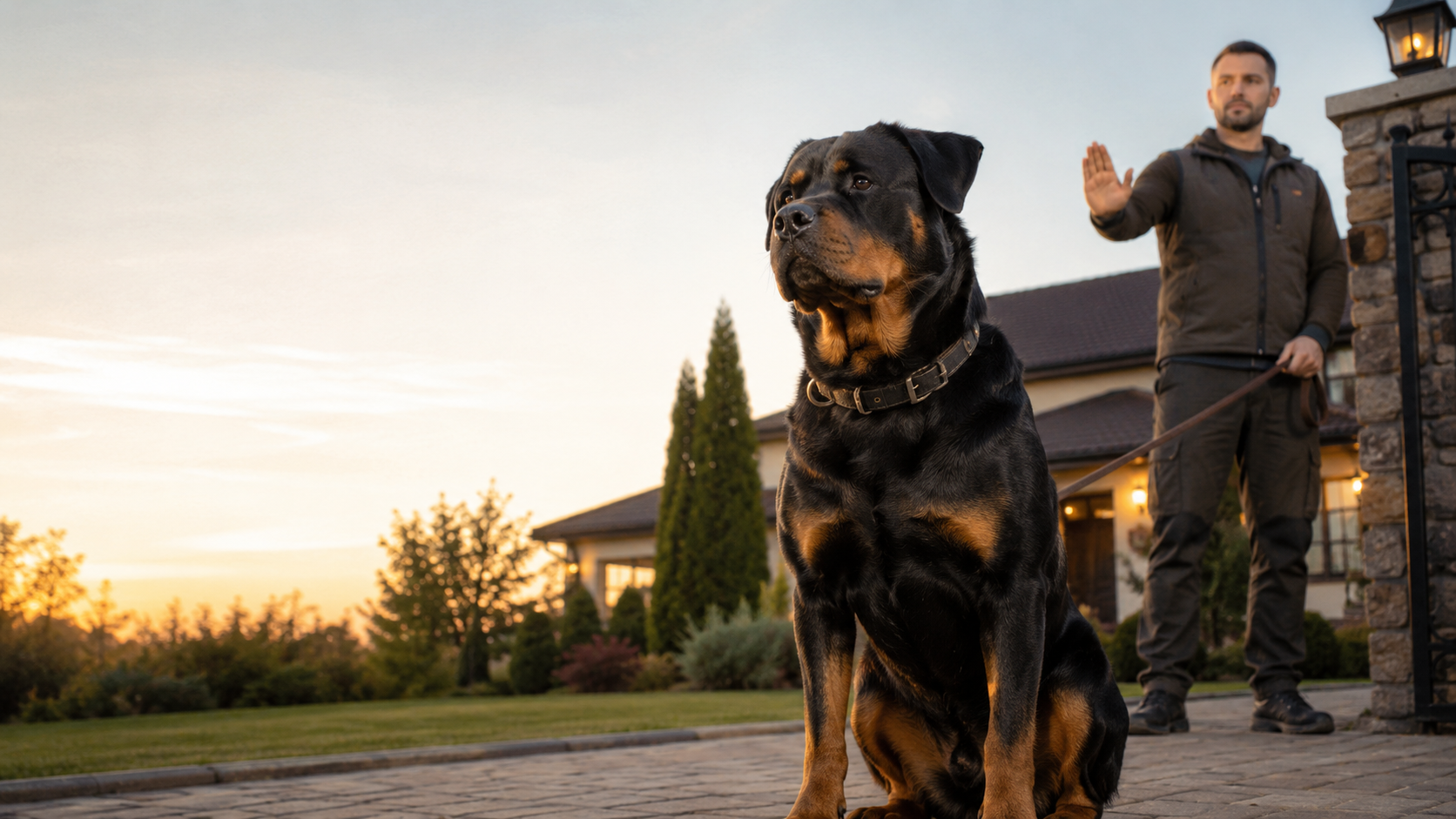
Are Rottweilers naturally good guard dogs?
Yes. The Rottweiler was developed as a working breed and still has many characteristics that make it naturally suited to guarding. A typical well-bred Rottweiler tends to be:
- Confident
- Observant
- Loyal to its family
- Physically imposing
- Intelligent
- Reserved around unfamiliar people
- Willing to work with its handler
The official Rottweiler breed standard describes the breed as calm, confident and courageous, with an inherent desire to protect home and family. That does not mean every Rottweiler automatically knows how to distinguish a burglar from the UPS driver. Good judgment develops from temperament, experience, socialization and training.
The best guardian is usually not the dog making the most noise. It is the dog calmly watching everything. Our complete Rottweiler training guide shows how to build exactly that kind of stability.
The 3 levels of Rottweiler guard dogs
People often use terms such as guard dog, watchdog and protection dog as if they mean the same thing. They don't. There are roughly three levels worth understanding:
- Alarm dog
- Threat dog
- Physical protection dog or "man-stopper"
The difference between them is enormous. For most families, the first or second level is more than enough.
Level 1: The alarm dog
An alarm dog has one simple job: notice someone approaching and tell you about it. Think of the dog as a furry security alarm. Someone walks onto the property. Your Rottweiler notices. The dog barks. You investigate. That's it.
An alarm dog does not need to confront anyone and certainly does not need to bite. The goal is awareness rather than physical protection.
What makes a good alarm dog?
- Alertness
- Confidence
- Awareness of the environment
- A recognizable alert bark
- Ability to settle again afterward
- Responsiveness to the owner
Interestingly, size is not particularly important at this level. A tiny terrier can be an excellent alarm dog. But a barking Rottweiler has an additional advantage: the person outside usually knows that the bark belongs to something considerably larger than a Chihuahua.
Training goal
Your Rottweiler should learn the difference between "something is happening" and "everything that moves is a threat." You want controlled alerting, not nonstop territorial barking. A useful household routine is therefore:
Notice → alert → owner investigates → dog settles.
The settling part is just as important as the barking.
Level 2: The threat dog
The second level adds something extremely powerful: deterrence. A threat dog does not need to attack someone to make that person reconsider entering your property. The dog's presence, posture and confidence may be enough.
Picture two dogs behind a gate. Dog A barks furiously while backing away. Dog B gives two deep barks, stands still and watches you. Which one would make you reconsider opening the gate? Probably Dog B. That is the difference between noise and confidence.
A good threat dog should stand its ground
A useful guardian should not panic when an unfamiliar person approaches. Instead, the dog should remain:
- Confident
- Alert
- Stable
- Responsive to the handler
- Comfortable maintaining distance
- Able to disengage when told
Size certainly helps. A mature Rottweiler standing calmly between its family and an unfamiliar person creates considerable psychological deterrence. But attitude matters more than theatrics. A nervous dog barking uncontrollably is not necessarily protecting anything. It may simply be frightened.
Confidence is not aggression
This distinction is extremely important. You do not want to teach your Rottweiler: "Strangers are dangerous." You want your dog to learn: "My owner decides what is normal." That is why socialization plays such a large role in producing a reliable guardian. A dog must experience thousands of normal situations before it can recognize when something genuinely feels unusual.
Level 3: The physical protection dog
The third level is fundamentally different. Historically, trainers sometimes called this type of protection dog a "man-stopper" — a dog capable of physically intervening when a serious threat occurs. That is far beyond ordinary guard-dog training. A true personal protection dog requires an unusual combination of temperament, physical ability and control.
What qualities would such a dog need?
- Responsibility — the dog must remain committed to its handler rather than becoming distracted by movement, noise or excitement.
- Awareness — excellent environmental awareness without becoming nervous about everything around it.
- Decisiveness — awareness alone is useless if a working dog freezes under pressure. A suitable dog needs enough confidence to make decisions while remaining responsive to its handler.
- Courage — stress should not immediately cause panic, avoidance or uncontrolled aggression.
- Capability — both the physical condition and mental stability required for demanding work.
- Judgment — perhaps most importantly, a protection dog needs an "off switch." If you welcome someone onto your property, your Rottweiler must respect that decision.
A dog that cannot safely coexist with visitors is not an impressive protection dog. It is an unsafe dog that will spend much of its life being locked away whenever someone visits. That defeats the entire purpose.
This is where DIY training ends
Training a dog for physical confrontation involves serious safety and liability risks. It should therefore be performed only within a structured professional program after the dog's temperament and suitability have been evaluated. Do not attempt to recreate bite-work exercises from social media videos at home. Read more in our guide to Rottweiler protection training.
How to train a Rottweiler to be a guard dog: start with these foundations
For the average Rottweiler owner, the safest route to a trustworthy guardian is surprisingly boring. You build an exceptionally well-trained dog first. Only then do you decide whether anything more is necessary.
1. Build excellent basic obedience
Your Rottweiler should reliably understand skills such as sit, down, stay, come, place, leave it, drop it, loose-leash walking, settle and attention to handler. These skills create communication — and communication is what gives you control when something unexpected happens. A 110-pound adult Rottweiler that ignores basic commands should not be doing advanced guarding work. Start with our Rottweiler basic commands guide and build real-world reliability before considering anything more advanced.
2. Socialize your Rottweiler properly
This sounds contradictory. Why would you socialize a dog that you want to guard your house? Because a dog cannot recognize abnormal situations unless it first understands normal ones. Your Rottweiler should experience ordinary life:
- Delivery drivers and visitors
- Children
- Cyclists and joggers
- People wearing hats or carrying bags
- Cars arriving and doorbells
- Other dogs
- Veterinary visits
- Busy streets and quiet neighborhoods
The objective isn't to make your Rottie run up and kiss every stranger. Neutrality is perfectly fine. Your dog simply needs to learn that ordinary people doing ordinary things are not automatically threats. See our Rottweiler puppy socialization guide.
3. Teach your dog to look to you for decisions
This may be one of the most valuable guardian skills you can develop. When something unusual happens, you want this sequence:
Rottweiler notices something → Rottweiler checks owner → owner gives direction.
Not: Rottweiler notices something → Rottweiler makes every decision itself. Reward voluntary check-ins during walks and around distractions. Over time, your dog learns that looking to you is part of handling uncertainty.
4. Teach a reliable place command
Imagine someone rings your doorbell. Your 115-pound Rottweiler charges toward the entrance. You open the door while holding the dog's collar. The visitor squeezes past. Everyone is stressed.
Now compare that with: Doorbell → "Place" → Rottweiler goes to mat → visitor enters → dog remains under control.
Which dog would you rather live with? A strong place command may be more useful for home security than teaching dramatic guarding behavior. You remain in control of the situation.
5. Teach an off switch
Good guardians spend far more time relaxing than guarding. Your Rottweiler should be able to go from alert to finished without remaining agitated for twenty minutes. Reward calm behavior after unusual sounds, visitors or activity around the property. The ability to settle tells you a lot about the dog's emotional stability.
6. Don't encourage random aggression
Owners sometimes unintentionally create behavior problems while trying to make their Rottweiler "protective." For example: a puppy barks at someone outside. The owner becomes excited. "Good boy! Get him!" The puppy learns: strangers outside = owner wants me excited. Repeat that hundreds of times and you may not create a protection dog. You may create a reactive dog. Reward calm observation and responsiveness instead.
Rottweiler training age: when should guard training begin?
People searching for a Rottweiler training age often want one specific number. There isn't one. Training starts immediately. Protection training does not.
8–16 weeks
Focus on socialization, name recognition, recall games, handling, confidence, household routines, positive experiences and engagement with the owner. Your puppy does not need guarding exercises. The world itself is already one giant training exercise.
4–6 months
Continue basic obedience, loose-leash walking, impulse control, place training, calm greetings and environmental confidence.
6–18 months
Adolescence often makes Rottweilers look considerably more impressive while their brains temporarily seem to have gone on vacation. Continue building reliability, focus, neutrality, recall, calm behavior and confidence. Do not mistake adolescent barking or territorial behavior for proof that your dog is ready for protection training.
Mature dog
Advanced protection work should only be considered after temperament, health and training foundations have been assessed by an experienced professional. There is no magic Rottweiler protection training age that applies to every dog. Our Rottweiler obedience guide covers what reliability looks like at each stage.
Will a Rottweiler protect me without training?
Possibly. Many Rottweilers naturally become very attached to their owners and are naturally watchful of their homes. A confident Rottweiler may:
- Bark when someone approaches
- Move closer to its owner
- Stand between its owner and an unfamiliar person
- Watch strangers carefully
- Investigate unusual noises
That alone can provide considerable deterrence. But will a Rottweiler protect its owner during a genuine violent encounter? Nobody can guarantee that. Dogs are individuals. Some may confront a threat. Others may bark. Some may retreat. Some may freeze. You should never deliberately put yourself or your dog in danger to test the theory.
Will a Rottweiler attack an intruder?
Maybe — but breed alone cannot predict what an individual dog will do. A Rottweiler may bark, block access, retreat, approach the person or react in another way entirely. Even professionally trained dogs are not robots.
More importantly, you generally don't need an attacking dog to make your home less attractive to an intruder. Imagine seeing this through a window: a muscular 110-pound Rottweiler staring directly at you. For most burglars, that is already useful information.
Will a Rottweiler turn on its owner?
A properly raised Rottweiler does not suddenly have a secret switch that makes it "turn" on its family. When serious aggression occurs, there is usually context behind it. Potential factors can include:
- Fear
- Pain
- Resource guarding
- Poor socialization
- Conflict
- Punishment-based training
- Stress
- Medical problems
- Previous learning
- Genetics
That is why sudden behavioral changes should always be taken seriously. If an otherwise stable Rottweiler unexpectedly becomes aggressive, speak with your veterinarian and an appropriately qualified behavior professional.
Will a Rottweiler bite its owner?
Any dog with teeth can bite. That includes a Rottweiler. But biting should never be considered a normal or inevitable part of owning the breed. Most Rottweilers raised with good socialization, humane training, sensible management and appropriate handling develop strong relationships with their families.
If your Rottweiler growls, snaps or bites, don't try to "show him who's boss." Growling is information. Determine why the behavior occurred and seek professional help when necessary. Punishing warning signals can make future behavior harder to predict.
Guard dog vs protection dog
Here is the simplest way to remember the difference:
| Type | Primary job | Physical confrontation required? | Suitable for ordinary family homes? |
|---|---|---|---|
| Alarm dog | Detect and announce | No | Yes |
| Threat dog | Alert and deter through confident presence | No | Often |
| Personal protection dog | Professionally trained physical protection | Potentially | Specialist circumstances only |
Most Rottweiler owners who say "I want a guard dog" actually want Level 1 or Level 2. And that is good news. Your Rottweiler's natural appearance and temperament already do a considerable amount of the work.
Rottweiler protection training near me: how to choose a trainer
If you've reached the point where you're searching for Rottweiler protection training near you, don't simply choose whoever owns the biggest bite sleeve. Interview the trainer. Ask about:
- Experience with Rottweilers and working breeds
- Training philosophy
- Temperament evaluation
- Socialization and obedience requirements
- Handler involvement
- Safety procedures
- Professional qualifications
- What happens if your dog is considered unsuitable
One of the biggest green flags? A trainer who is perfectly willing to say: "Your dog should not do protection work." A professional should evaluate the individual dog rather than assume every Rottweiler is suitable. Avoid trainers who promise to make your dog "mean," deliberately provoke fear or aggression, or rely on pain and intimidation.
What about a Rottweiler protection dog for sale?
Search for a Rottweiler protection dog for sale and you may find fully or partially trained dogs advertised for very substantial prices. Buying a trained dog is not like buying a security system. The dog-handler relationship still needs to work. Before considering one, investigate:
- Breeder and trainer reputation
- Health testing
- Temperament
- Training history
- Social behavior and household suitability
- Commands the dog understands
- How handler transfer is conducted
- Veterinary records
- Insurance implications, local laws and liability
A demonstration video proves very little about how a dog behaves in everyday life. Ask to see how the dog behaves when absolutely nothing exciting is happening. Can it walk past strangers? Can it relax? Can it ignore another dog? Can someone safely examine it? Can it settle inside a house? Those qualities matter enormously.
The best guard Rottweiler is usually a calm Rottweiler
Movies have given us a strange picture of guard dogs: snarling, barking, pulling against chains, throwing themselves against gates. In real life, uncontrolled aggression is not impressive. Control is impressive.
Imagine two Rottweilers. Rottweiler A: the doorbell rings, the dog erupts, jumps at the door, ignores commands and continues barking long after the visitor has entered. Rottweiler B: the doorbell rings, the dog gives a deep alert bark and looks toward his owner. "Place." He walks to his mat and watches quietly while the owner opens the door.
Which dog would you trust more? Rottweiler B is exactly the type of dog you want.
The guard dog training pyramid
Think of reliable guardian behavior as a pyramid. At the bottom:
- Socialization
- Owner relationship
- Basic obedience
- Impulse control
- Environmental confidence
- Reliable alerting and household boundaries
And only at the very top, for a small percentage of suitable dogs: professionally supervised protection work. Skip the lower levels and the entire structure becomes unstable.
Should you train your Rottweiler as a guard dog?
For most owners: yes — but probably not in the way you imagined. Teach your Rottweiler to:
- Notice its surroundings
- Alert appropriately
- Remain confident
- Look to you for guidance
- Stop barking when asked
- Go to a designated place
- Accept invited visitors
- Ignore ordinary strangers
- Walk calmly in public
- Respond reliably to commands
Combine that behavior with the natural presence of an adult Rottweiler and you already have an impressive guardian. Advanced physical protection is a specialist discipline. Everyday guardian behavior is simply excellent Rottweiler training.
Your next step: build the guardian before the guard dog
A Rottweiler already comes with something most security systems don't have: presence. You don't need to manufacture aggression. Develop the qualities that make the breed impressive in the first place: confidence, intelligence, stability, loyalty and control. Start with obedience. Build neutrality. Reward calm decisions. Teach your dog to look to you when something unusual happens. For most families, that creates exactly the Rottweiler guardian they were hoping for.
Continue training your Rottweiler
Rottweiler Training Guide
Build the complete foundation from puppyhood to reliable adult obedience.
Rottweiler Basic Commands
Teach recall, stay, place, leave it and other essential commands.
Rottweiler Obedience Training
Turn commands your Rottie knows at home into skills that work in the real world.
Rottweiler Protection Training
Interested in advanced working-dog training? Read our guide to professional protection training, IGP and selecting a suitable trainer.
Frequently asked questions
How do you train a Rottweiler to be a guard dog?
Start with socialization, basic obedience, impulse control, environmental confidence, a reliable place command and controlled alerting. For most family Rottweilers, these skills provide useful guarding and deterrence without teaching physical confrontation.
Are Rottweilers naturally protective?
Yes. Rottweilers were developed as working dogs and the breed is known for confidence, watchfulness and a natural desire to protect home and family. Individual temperament still varies considerably.
Will a Rottweiler protect me without training?
Some Rottweilers naturally alert or position themselves near their owner when something feels unusual. However, there is no guarantee that an untrained dog — or even a trained dog — will physically intervene during a real emergency.
Will a Rottweiler attack an intruder?
It is impossible to predict with certainty. A Rottweiler might bark, approach, retreat, block access or respond differently depending on the dog and situation. Never create a dangerous scenario to test your dog's reaction.
At what age should a Rottweiler start guard dog training?
Basic training and socialization should begin during puppyhood. Formal protection work is different and should only be considered later after the individual dog's maturity, temperament, health and obedience have been professionally evaluated.
Will a Rottweiler turn on its owner?
Rottweilers do not randomly “turn” on owners simply because of their breed. Aggression usually has behavioral, environmental, medical or learning-related context. Sudden aggression warrants veterinary and professional behavioral evaluation.
Will a Rottweiler bite its owner?
Any dog can bite under certain circumstances, but biting its owner is not an inevitable or normal characteristic of the Rottweiler breed. Pain, fear, guarding, conflict and other behavioral issues should be investigated if aggression occurs.
Is protection training the same as guard dog training?
No. A family guard dog may simply alert its owner and provide deterrence. Personal protection training involves highly specialized work and should only be conducted under experienced professional supervision.
How do I find Rottweiler protection training near me?
Look for trainers experienced with Rottweilers and working breeds who evaluate temperament before accepting a dog. Ask about training methods, safety, handler education and obedience requirements rather than choosing a trainer based solely on dramatic protection demonstrations.
Can I buy a trained Rottweiler protection dog?
Yes, trained protection Rottweilers are commercially available, but buyers should carefully investigate temperament, health testing, training history, everyday behavior and how the dog will be transferred to a new handler. A professionally trained dog still requires responsible handling and ongoing training.
Sources and further reading
- American Kennel Club — Rottweiler breed information
- American Rottweiler Club — breed standard and working activities
- American Veterinary Society of Animal Behavior — position statements on humane training
- Continue training with our Rottweiler Training Guide, Basic Commands, Obedience Training and Rottweiler Protection Training guides.
This guide provides general educational information and is not an individual training or behavior plan. Sudden behavior change can have a medical cause. If your Rottweiler shows fear, panic, guarding, aggression or a bite risk, contact your veterinarian and a qualified reward-based behavior professional.