
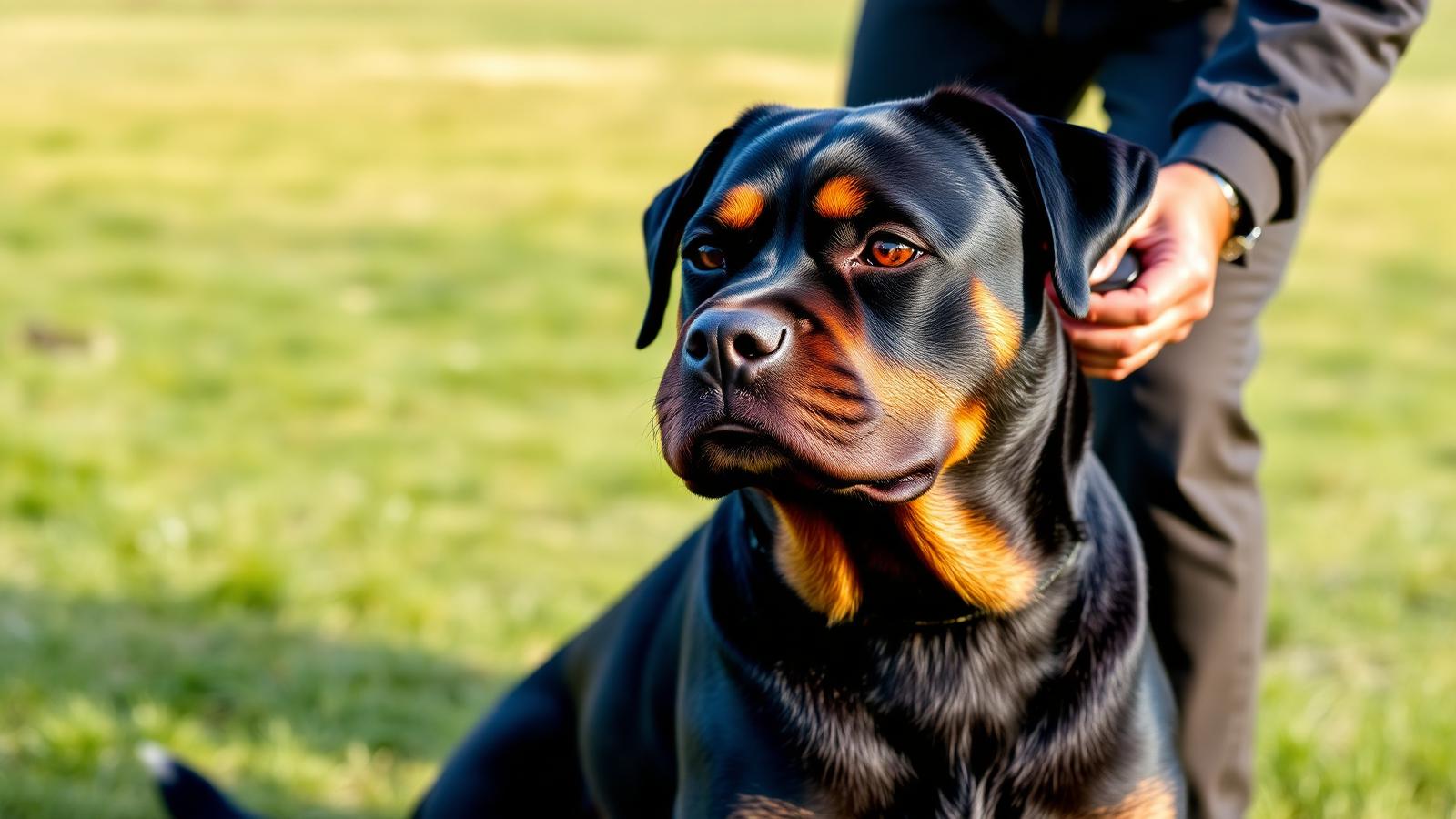
Rottweiler Obedience Training: Build Real-World Reliability
Your Rottweiler may understand sit in the kitchen and still appear to forget it beside a busy trail. That is not proof of stubbornness. Dogs learn in context, and reliability grows only when you practice the same skill across carefully chosen places, distances, durations and distractions.
Use the basic Rottweiler commands guide to teach the first version of each behavior. This page begins where that tutorial ends: turning a newly learned cue into dependable communication without making training harder than the dog can handle.
Last reviewed: August 2026
What does obedience mean?
Modern obedience is not passive submission. It is a fluent set of cooperative behaviors that lets a dog participate safely in family and public life.
A reliable Rottweiler can increasingly:
- Respond to familiar cues without seeing food first
- Maintain a behavior until released
- Work at an appropriate distance
- Disengage from manageable distractions
- Recover after surprise or excitement
- Generalize a skill across surfaces and locations
- Tell you when an environment is currently too difficult
No dog is a machine. Legal restrictions, traffic, wildlife, health and the behavior of other dogs still require management even when training is excellent.
The three proofing variables
Duration
How long can the dog maintain the behavior? Increase in small, uneven increments rather than adding one second every time. Reward some easy repetitions among harder ones.
Distance
How far can you move while the behavior continues? Distance includes lateral movement, walking behind the dog and sending the dog away from you. Each version can feel different.
Distraction
What competes for attention? A food bowl, visitor, dog, bicycle, wildlife scent and unfamiliar floor are not equivalent. Build a hierarchy for the individual dog.
Change only one main variable at a time. If you increase distance, shorten duration and reduce distraction. Raising all three together makes failure likely and teaches repeated breaking of position.
Use a training ladder instead of a test
Create five levels for one skill. A recall ladder might be:
- Indoors, five feet away, no competing activity
- Indoors from another room
- Secure yard with a mild scent distraction
- Quiet open area on a long line
- Moderate real-life distractions at a safe distance on a long line
Move up after several easy successes across more than one session. Drop one or two levels if response speed or confidence deteriorates. Progress is rarely a straight line.
Rottie training tip — Keep a success rate, not a pride score
If your dog succeeds fewer than roughly four times out of five, make the next repetition easier. This is a training adjustment, not a judgment about the dog.
Generalize one behavior across contexts
For each important cue, vary:
- Room and direction within the room
- Surface: rug, grass, pavement or mat
- Your position: standing, sitting or moving
- Time of day
- Reward type
- Familiar people nearby
- Weather and sound level
- Safe distance from dogs, traffic or wildlife
Do not jump directly from the living room to a crowded dog park. Dog parks are uncontrolled environments, not necessary obedience classrooms. A quiet parking area, wide trail or edge of a park often provides more useful adjustable distance.
Reinforcement after the dog knows the cue
New or fragile behavior benefits from frequent reinforcement. Once the cue is fluent in that context, vary which repetition earns food while continuing to use life rewards and occasional high-value payment.
Examples:
- Loose leash makes the walk continue
- Recall earns food and a release back to sniffing
- Waiting opens the door
- Mat behavior earns calm access to family activity
- Dropping a toy restarts play
Do not eliminate reinforcement because the dog is an adult. Behaviors with major safety value—especially recall and disengagement—should remain worth performing.
Fade the lure, not the reward
A lure helps create behavior but can become a visible bribe.
- Perform the same hand motion without food in that hand.
- Mark the behavior.
- Retrieve reinforcement from a pocket or nearby container.
- Gradually make the hand signal smaller.
- Alternate food with other meaningful outcomes only after performance is stable.
The dog learns that responding makes reinforcement appear; food does not need to be shown first.
Proofing stay and place
Build calm stationary behavior through:
- Very short successful holds
- Frequent rewards delivered in position
- A consistent release cue
- Returning to the dog rather than calling out every time
- Minor handler movement before walking away
- Mild household distractions before visitor-level excitement
If the dog breaks, reset without scolding and reduce one variable. Repeated failure means the current criterion is too high.
Proofing recall safely
Use a secure environment or long line. Vary distance, your position and manageable distractions separately.
- Reward arrival at your body, not several feet away
- Practice a gentle collar or harness touch before release
- Occasionally release back to the previous activity
- Avoid calling when you know the dog cannot succeed and safety is not secured
- Use an emergency recall word only for extremely valuable, rehearsed outcomes
- Do not punish slow arrival after the dog finally comes
Off-leash freedom depends on location, law, wildlife, visibility and risk—not a percentage score. A dog who succeeds nine times can still be injured on the tenth.
Impulse control without constant waiting
Impulse control develops when the dog learns that calm behavior gives access to something valued. Practice short pauses at doors, before retrieving a toy, exiting the car and greeting known people.
Do not require prolonged stillness before every normal need. Dogs also need movement, sniffing and choices. The goal is flexible self-control, not suppressing all spontaneous behavior.
Adolescence and temporary loss of reliability
Adolescence often brings more interest in the environment, stronger physical ability and changing social behavior. A cue that appears weaker outdoors usually needs renewed reinforcement and lower distraction.
Return to:
- A long line or barrier for safety
- Shorter sessions
- Greater distance from triggers
- More valuable reinforcement
- Easier versions mixed with one challenge
- Adequate rest and appropriate enrichment
Do not respond by escalating physical corrections. This can attach fear or conflict to the handler and the environment.
Classes, sports and credentials
A good group class offers controlled distractions and coaching. Choose a class whose entry requirements, spacing and methods suit your dog. A fearful or reactive dog may need individual work before a standard group class.
Possible goals include:
- Family manners or life skills
- Rally obedience
- Formal competitive obedience
- Scent work or tracking
- Cooperative care
- Canine Good Citizen-style assessment where available
- Breed or working-dog activities taught with humane methods
IGP, BH and other sport titles involve specific rules and should not be presented as requirements for responsible Rottweiler ownership. Sport credentials also do not automatically prove that every training method used is humane.
A four-week proofing template
This is a practice structure, not a promise that behavior will be finished in four weeks.
| Week | Focus | Example |
|---|---|---|
| 1 | Define criteria and baseline | Record duration, distance and distraction where success is easy |
| 2 | Generalize location | Practice the same easy cue in three quiet places |
| 3 | Add one distraction | Work at a distance where the dog can still eat and respond |
| 4 | Combine modest variables | Slightly more duration in a familiar outdoor location |
At the end, repeat the baseline and decide which variable needs the next training cycle.
When obedience is not the whole answer
A frightened dog may perform a cue and still feel afraid. A dog in pain may be physically unable to sit or down comfortably. A dog with separation distress does not need stricter stays.
Professional help
Professional help
Contact your veterinarian for sudden performance changes, reluctance to sit or lie down, touch sensitivity, reduced stamina or new irritability. Seek a qualified behavior professional for fear, panic, guarding, aggression or reactivity that requires an emotional-change plan—not simply more commands.
RottieBuddy may earn a commission from qualifying purchases, at no extra cost to you. Product links never replace professional training or veterinary advice.
Practice recall and distance with an appropriate safety setup.
Compare fixed-length long lines and reward-delivery tools for gradual proofing. Never use equipment as a substitute for a safe environment.
Compare Rottweiler Long LinesContinue your training plan
Frequently asked questions
How long does Rottweiler obedience training take?
Simple cue mechanics may develop quickly, but reliability across real environments is an ongoing process. The dog, goal, reinforcement history and setting all matter.
When should I stop using treats?
Reduce visible lures once the behavior is predictable, then vary reinforcement gradually. Continue rewarding difficult and safety-critical responses.
What should I do when my dog ignores a known command?
Secure safety, avoid repeating the cue and lower distance, duration or distraction. Also consider motivation, fatigue, stress and physical comfort.
Does an obedience class fix behavior problems?
Not necessarily. A class teaches skills, while fear, guarding, panic or aggression may need veterinary assessment and an individualized behavior plan.
When is a Rottweiler ready for off-leash walking?
There is no universal milestone. Consider law, location, wildlife, traffic, recall history and the consequences of one failure. A long line remains valuable even for well-trained dogs.
Can rescue and adult Rottweilers learn advanced obedience?
Yes. Start with the actual baseline and allow time to build trust, reinforcement history and context-specific skills.
Sources and further reading
- American Veterinary Society of Animal Behavior — Position statements and trainer selection
- AVSAB — Dominance Position Statement
- Merck Veterinary Manual — Behavior problems of dogs
- American Animal Hospital Association — 2019 Canine Life Stage Guidelines
This guide provides general educational information and is not an individual training or behavior plan. Sudden behavior change can have a medical cause. If your Rottweiler shows fear, panic, guarding, aggression or a bite risk, contact your veterinarian and a qualified reward-based behavior professional.
This guide provides general educational information and is not an individual training or behavior plan. Sudden behavior change can have a medical cause. If your Rottweiler shows fear, panic, guarding, aggression or a bite risk, contact your veterinarian and a qualified reward-based behavior professional.