
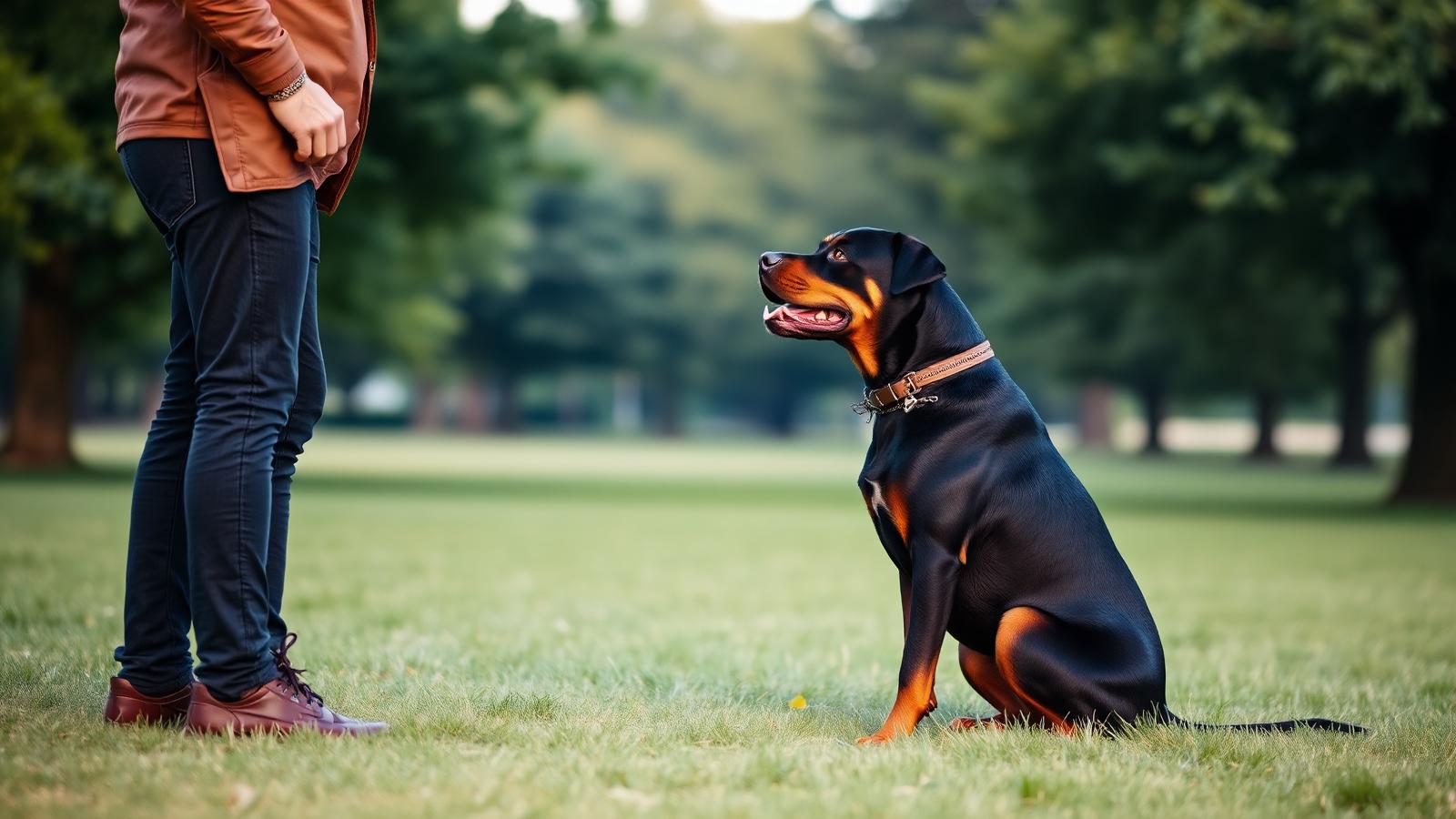
Basic Rottweiler Commands: A Reward-Based Step-by-Step Guide

A useful command is more than a word. Your Rottweiler must understand the behavior, recognize the cue, perform it in that environment and know when the behavior is finished. Teach the mechanics in a quiet place before expecting success around people, dogs or traffic.
Use small measured treats, a clicker or short marker word and sessions that end while your dog remains engaged. Never physically force a sit or down; create the behavior, mark it and reinforce it.
Last reviewed: August 2026
Before you teach the first cue
Prepare:
- A quiet, nonslip training area
- Small rewards your dog can swallow quickly
- A marker such as a click or
yes - A release word such as
free - A short leash only if needed for safety, not correction
- A plan for five or fewer successful repetitions at first
Say a cue once. If the dog does not respond, reduce difficulty or help with the trained gesture rather than repeating the word louder.
1. Name response and eye contact
- Wait until your dog is mildly distracted, not staring at you.
- Say the name once.
- Mark the moment the head turns toward you.
- Deliver the reward near your body.
- Pause before another repetition.
If there is no response, make the environment easier. Avoid using the name before something the dog dislikes.
2. Hand target: “touch”
A hand target moves a dog without pushing or grabbing.
- Present an open palm a few inches from the nose.
- Mark any deliberate nose contact.
- Reward from the other hand.
- Move the target slightly to each side.
- Add
touchwhen contact is predictable.
Use it to reposition for grooming, recall, doorways and loose-leash walking.
3. Sit
- Hold a reward near the nose.
- Move it slowly upward and slightly back.
- Mark when the rear touches the floor.
- Reward low enough that the dog remains seated.
- Use the release cue and reset.
- Add
sitimmediately before the hand motion once the movement is reliable.
If the dog backs up, train near a wall without trapping them or capture sits the dog offers naturally. Do not push down on the hips.
4. Down
- Begin with the dog standing or sitting on a nonslip surface.
- Move a reward from the nose straight toward the floor.
- Slowly draw it forward as the elbows lower.
- Mark the instant both elbows touch.
- Reward between the paws and release.
Some large dogs find a folded position uncomfortable. Try from standing, use a raised platform as an intermediate step or ask your veterinarian if the dog consistently avoids down on all surfaces.
5. Stay—and the release cue
Stay means maintain position until released. Build one variable at a time:
- Ask for sit or down.
- Pause for half a second.
- Mark and reward in position.
- Say the release cue and toss a reset reward.
- Increase duration by tiny amounts.
- Add one small step of distance only after the dog understands duration.
- Add mild distraction last.
Return to the dog to reward most early repetitions. Calling the dog out of every stay turns the end into a recall rather than teaching steady position.
Rottie training tip — Release is a real cue
A clear free or all done prevents your dog from guessing when sit, down, stay, place or a doorway pause has ended. Reinforce waiting for that release.
6. Come when called
Recall is built through reinforcement, not tests.
- Begin a few feet away indoors.
- Say the recall cue once in a cheerful voice.
- Move backward to encourage approach.
- Mark as the dog commits to you.
- Reward at your body and briefly hold the collar or harness before releasing.
- Gradually add distance in secure spaces.
- Use a long line outdoors until the environment is safe and the skill is strong.
Do not call for something the dog dislikes when you can calmly go and get them. Sometimes recall, reward and release back to play so coming does not always end freedom.
For a puppy-specific progression, use the Rottweiler puppy recall guide.
7. Leave it
Leave it applies before the dog takes an item.
- Hide a low-value item in a closed fist.
- Wait silently while the dog investigates.
- Mark the first deliberate move away.
- Reward from the other hand.
- Repeat until the closed fist prompts disengagement.
- Progress to an item under your foot, then visible at a safe distance.
- Add the verbal cue before presenting the setup.
Never reward by giving the item the dog was asked to leave. Pay from a separate source.
8. Drop it
Drop it means release an item already held.
- Offer a safe, low-value toy.
- Present a better reward near the nose.
- Mark when the mouth opens.
- Give the reward and return the toy when safe.
- Add
dropjust before presenting the trade. - Progress to more valued objects gradually.
Frequent returns prevent the exercise from meaning permanent loss. Do not pry open the jaws or chase. Use the destructive chewing guide for stolen-object management.
9. Place or mat
- Put a nonslip mat on the floor.
- Mark looking at, approaching or stepping on it.
- Deliver rewards on the mat.
- Shape all four paws onto it.
- Reinforce a sit or down there.
- Build relaxation and duration before distance.
- Add
placeormatonce movement toward it is predictable.
Use place during meals, visitors and calm household activity. It should not become prolonged social isolation.
10. Wait at doors
Wait can mean a temporary pause rather than a formal stay.
- Approach the closed door on leash.
- Reward a loose leash and stationary paws.
- Open the door a fraction.
- Close it calmly if the dog surges forward.
- Reopen as the pause returns.
- Give a separate release cue to move through together.
The door opening is part of the reinforcement. Do not use your body to intimidate the dog backward.
Common command-training problems
| Problem | Likely issue | Adjustment |
|---|---|---|
| Responds only when food is visible | Food became part of the cue | Hide food, mark first, then retrieve the reward |
| Cue works only at home | Insufficient generalization | Practice in gradually varied easy places |
| Dog gets up before release | Release cue or duration is unclear | Shorten the interval and reward in position |
| Dog ignores repeated words | Cue has become background noise | Say it once and lower difficulty |
| Dog avoids down | Surface, physical comfort or teaching step | Add traction and assess possible pain |
| Recall slows outdoors | Competing environment is too valuable | Use distance, long line and better reinforcement |
Safety first
Safety first
Do not practice recall off leash in an unsecured area simply to test it. A long line attaches to a well-fitted harness and requires space away from traffic, people and other dogs. Wear gloves if needed, avoid wrapping it around hands and never use it for abrupt high-speed stops.
RottieBuddy may earn a commission from qualifying purchases, at no extra cost to you. Product links never replace professional training or veterinary advice.
Keep feedback clear and rewards easy to deliver.
Compare clickers and treat pouches that support precise timing without pretending equipment replaces practice.
Compare Training ClickersContinue your training plan
Looking for the complete training roadmap? See our Rottweiler Training Guide.
Frequently asked questions
Which commands should a Rottweiler learn first?
Start with name response, touch, recall, sit, leave it, drop it and a release cue. The best order depends on daily safety needs.
Should I say a command before luring?
First make the behavior predictable. Then say the cue once immediately before the known gesture so the word gains meaning.
How many times should I repeat each command?
Use a small number of successful repetitions and stop before attention drops. Quality matters more than a fixed count.
Why does my Rottweiler obey only when I have treats?
The visible treat may have become part of the cue. Keep rewards out of sight, mark the correct behavior and then retrieve payment.
Is “heel” the same as loose-leash walking?
No. Heel is a precise position useful for short periods. Loose-leash walking allows more freedom as long as the leash remains slack.
Can an adult Rottweiler learn basic commands?
Yes. Adults can learn throughout life. Begin in an easy environment and adapt for previous learning, health and motivation.
Sources and further reading
- American Veterinary Society of Animal Behavior — Humane Dog Training Position Statement
- AVSAB — Dominance Position Statement
- Merck Veterinary Manual — Behavior modification in dogs
This guide provides general educational information and is not an individual training or behavior plan. Sudden behavior change can have a medical cause. If your Rottweiler shows fear, panic, guarding, aggression or a bite risk, contact your veterinarian and a qualified reward-based behavior professional.