From Tiny Potato to Tiny Tank: What Living With a Rottweiler Puppy Really Looks Like
From shark teeth and zoomies to stolen socks and training breakthroughs — this is what life with a Rottweiler puppy between 7 and 12 weeks actually feels like.
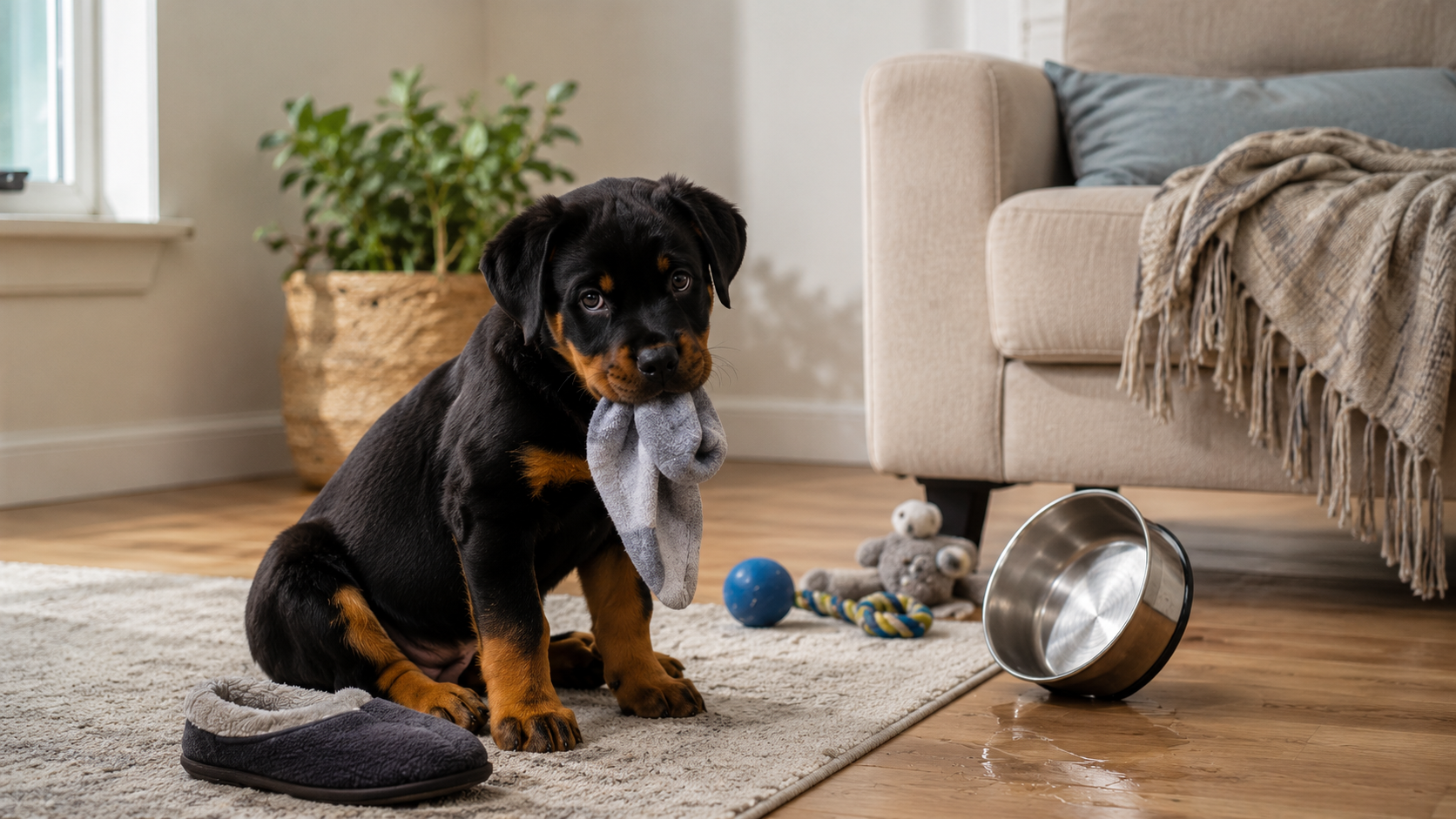
There is a very specific moment in Rottweiler puppy ownership when you look at the adorable little dog sleeping next to you and think: “How can something this cute cause this much chaos?” Usually, this happens shortly after your puppy has stolen a sock, tipped over the water bowl and attempted to eat something that definitely wasn't food.
Welcome to life with a young Rottweiler. The period between roughly seven and twelve weeks is fascinating because your puppy seems to change almost every day. One morning you have a sleepy little bear following you around the house. A few weeks later, you suddenly have a confident miniature Rottweiler testing whether your shoes, furniture and patience are chew-proof.
This isn't another week-by-week development chart. We already have a complete Rottweiler puppy development guide for that. Instead, this is what those early weeks actually feel like when you live through them.
Week 7: The Tiny Observer
A rottweiler puppy 7 weeks old is still very much a baby. Everything is information. The sound of a vacuum cleaner. A door closing. Someone wearing a hat. A spoon falling onto the kitchen floor. Even their own reflection can briefly become the most suspicious thing they have ever seen.
At this age, puppies learn constantly by watching, smelling, touching and occasionally attempting to eat their environment. Their confidence is still developing, so new experiences should be gentle rather than overwhelming. A cardboard box can become an adventure. A different floor surface can become a training session. A calm visitor can become a valuable socialization experience.
You don't need to create an amusement park for your puppy. Normal life provides plenty of learning opportunities — the important thing is that those experiences are positive.
And yes, there will probably be accidents. Lots of them. Your puppy has not forgotten everything you taught them five minutes ago. Their bladder is simply tiny and their ability to predict future consequences is roughly equivalent to that of a potato.
Rottweiler at 8 Weeks: Welcome Home
For many owners, rottweiler 8 weeks is the moment the real adventure begins. This is often when puppies arrive in their new homes. The first evening may go surprisingly well. Your puppy explores the living room. Sniffs everything. Plays for ten minutes. Falls asleep. You start thinking: “This is going to be easy.”
Enjoy that feeling. It may last approximately twelve hours.
By the following morning your puppy has discovered electrical cables, shoes, rugs, table legs and the exciting possibility of sprinting through the house at maximum speed for no obvious reason.
The first days are not about perfect obedience. They are about helping your puppy understand:
- where to sleep
- where to go potty
- where food appears
- which things belong to them
- which things absolutely do not belong to them
- and most importantly, that their new humans are safe
If your puppy has just arrived home, our detailed guide to Rottweiler puppy development from 8–12 weeks goes deeper into what to expect during this important stage.
The Great Rottweiler Essentials Shopping Reality
Before bringing home a puppy, most owners create a list of rottweiler essentials. Bed. Collar. Leash. Food. Bowls. Crate. Toys. Everything looks wonderfully organized. Then the puppy arrives. The expensive bed? Ignored. The carefully selected chew toy? Moderately interesting. The cardboard box the toy arrived in? The greatest object ever created.
Young Rottweilers are excellent at reminding us that puppies don't care how much something costs. That doesn't mean good equipment isn't important — a suitable crate, safe chew toys, puppy food, a comfortable collar or harness and proper food and water bowls can make those first weeks significantly easier. See our crate picks and the full Rottweiler Buyer's Guide for tested recommendations.
But one of the most useful Rottweiler essentials costs almost nothing: consistency. Same rules. Same routines. Same expectations. Puppies thrive when their world starts becoming predictable.
Week 9: The Confidence Upgrade
Somewhere around nine weeks, many puppies start becoming noticeably more adventurous. The puppy who cautiously followed you around three days ago suddenly decides they are ready to investigate the entire universe — usually beginning with whatever is under the sofa.
This is also when owners may notice their puppy experimenting more. What happens if I ignore you? What happens if I grab this towel? What happens if I run away when you say come?
None of this means your puppy is becoming dominant or difficult. They are simply learning. Every interaction teaches them something. If grabbing socks results in five minutes of humans chasing them around the living room, congratulations: you have accidentally invented the best game in the world.
Instead, this is the perfect time to start building simple habits: come when called, sit before meals, trade objects instead of stealing them back, relax calmly after play. Short training sessions are usually more effective than long ones — think three minutes of successful training rather than thirty minutes of frustration.
Living With an 11 Week Rottweiler Puppy
An 11 week rottweiler puppy can feel surprisingly different from the puppy you brought home only a few weeks earlier. Their body is growing. Their confidence is increasing. Their personality is becoming clearer. And their teeth appear to have been manufactured by a company specializing in industrial needles.
Puppy biting becomes one of the most common frustrations during this stage. Hands. Sleeves. Shoelaces. Trouser legs. Nothing is safe. But puppy biting is usually not aggression — it is often a mixture of exploration, play, excitement, teething and becoming overtired. Our Rottweiler puppy biting guide explains how to respond step by step.
In fact, one of the biggest secrets of puppy ownership is this: a completely insane puppy may simply need a nap. Many puppies become dramatically more chaotic when tired. If your puppy suddenly transforms into a tiny land shark every evening, consider whether they have had enough rest. Young puppies need a surprising amount of sleep.
The 12-Week Plot Twist
Then you reach twelve weeks. Your tiny baby suddenly begins looking suspiciously like an actual Rottweiler. A 12 week old rottweiler may already show flashes of the dog they will eventually become. They watch things more carefully. They recognize routines. They understand familiar words. They may follow you everywhere. And occasionally they perform something you actually trained them to do without being bribed.
This is usually followed by the owner proudly announcing: “He finally gets it!” Five minutes later the puppy is eating a leaf.
Still, twelve weeks is an exciting milestone. A 12 week old rottweiler puppy is old enough to begin building meaningful habits but still young enough that nearly everything feels new. That makes this period incredibly valuable. The goal is not to create a perfectly obedient puppy by twelve weeks — the goal is to create a puppy that enjoys learning.
Rottweiler 12 Weeks Old: The World Gets Bigger
When your rottweiler 12 weeks old starts becoming more confident, their world naturally begins expanding. More people. Different noises. New environments. Other dogs. Cars. Bicycles. Children. Strange objects. Different surfaces.
The temptation is to introduce everything as quickly as possible. But socialization is not a checklist where you simply expose your puppy to fifty things. Quality matters more than quantity. One calm experience near a bicycle can be more valuable than being overwhelmed by twenty bicycles in a busy city center.
Watch your puppy. Give them space. Let them observe. Reward curiosity. Confidence grows when puppies discover that unfamiliar things are manageable — not when they are forced into situations they find frightening. Our socialization guide walks you through this stage with a practical checklist.
Your Puppy Is Learning Even When You're Not Training
One of the biggest misconceptions about puppy training is that learning happens only during training sessions. It doesn't. Your puppy is learning when you open the front door, prepare their food, greet visitors, put on the leash, sit on the sofa, walk into another room or take something away.
Imagine your puppy jumps wildly every time you prepare dinner. If the food bowl immediately appears, jumping may become part of the dinner ritual. But if food only appears when four paws are on the floor, calm behavior starts becoming valuable. That is puppy training hidden inside normal life — and those small lessons add up quickly.
Don't Compare Your Puppy With Instagram Puppies
This deserves its own section. Somewhere online there is always a twelve-week-old puppy performing perfect recall, perfect heel, perfect sit-stay, and possibly filing its own tax return. Meanwhile, your puppy has just walked into a chair.
Do not panic. Puppies develop at different speeds. Some are naturally confident. Others are cautious. Some love food. Some love toys. Some concentrate easily. Others seem to have seventeen thoughts every second. Development is not a competition.
The important thing is whether your individual puppy is gradually becoming healthier, more confident and better able to understand the world. For a broader overview of the different stages ahead, bookmark our main Rottweiler puppy development timeline.
And Then Suddenly… Six Months
Here is the part nobody tells you: the tiny puppy phase disappears incredibly fast. One day you are carrying your Rottweiler puppy around the house. Not long afterwards you have a six-month-old dog who weighs considerably more and still occasionally believes they should be carried.
By the 6 month old Rottweiler stage, many puppies are entering adolescence. That means new challenges: more strength, more independence, more confidence — and sometimes selective hearing. Your beautifully trained puppy may suddenly appear to forget what the word “come” means. Don't assume your training failed. Adolescence is another stage of development, and the foundation you build during those early eight-to-twelve-week weeks becomes especially useful later.
What Actually Matters During These Early Weeks?
When owners think about puppy development, it is easy to focus on milestones: weight, commands, walking, training, growth. But some of the most important progress is harder to measure.
- Does your puppy trust you?
- Can your puppy relax?
- Are they curious about the world?
- Can they recover after something surprises them?
- Do they enjoy learning?
- Are everyday routines becoming easier?
Those small improvements eventually create the adult dog you want to live with.
Enjoy the Chaos
There will be difficult moments. Your puppy will bite. Something will probably get destroyed. There will be accidents. Training will occasionally seem to disappear overnight. You will question whether your puppy actually understands anything you are saying.
Then one day something changes. Your puppy looks at you before crossing a doorway. Comes running when you call. Chooses their toy instead of your shoe. Falls asleep next to you after a long day. And you realize all those tiny lessons are working.
That is what makes raising a Rottweiler puppy so rewarding. They do not transform from puppy into adult overnight — they grow through hundreds of tiny experiences. From the curious rottweiler puppy 7 weeks old, to the chaotic 11 week rottweiler puppy, to the increasingly confident 12 week old rottweiler puppy, and eventually into the powerful adult Rottweiler standing beside you.
So take photos. Laugh at the ridiculous moments. Keep training sessions short. Keep expectations realistic. And enjoy the tiny tank while they are still tiny — because they won't stay that way for long.
Continue your puppy's journey
Follow the complete Rottweiler Puppy Development Guide to see what changes as your puppy grows.
Frequently Asked Questions
What is a Rottweiler puppy like at 7 weeks old?
A 7-week-old Rottweiler puppy is still very much a baby. Everything is information: sounds, surfaces, visitors and even their own reflection. Confidence is still developing, so new experiences should be gentle, positive and never overwhelming. Normal household life provides plenty of learning opportunities.
Is 8 weeks a good age to bring a Rottweiler puppy home?
Yes, around eight weeks is the most common age for puppies to move to their new home. The first days are not about perfect obedience but about helping your puppy learn where to sleep, where to go potty, where food appears and, most importantly, that their new humans are safe.
Why is my 11-week-old Rottweiler puppy biting everything?
Puppy biting at this age is usually not aggression. It is a mixture of exploration, play, excitement, teething and becoming overtired. Many puppies become dramatically more chaotic when tired, so if your puppy turns into a tiny land shark every evening, check whether they have had enough sleep.
Should my 12-week-old Rottweiler already be fully trained?
No. The goal at twelve weeks is not a perfectly obedient puppy but a puppy that enjoys learning. Some puppies are naturally confident, others are cautious, and they all develop at different speeds. Development is not a competition — ignore the perfect Instagram puppies.
How much sleep does a young Rottweiler puppy need?
Young puppies need a surprising amount of sleep. An overtired puppy often becomes more chaotic, bitey and difficult to engage. Regular naps throughout the day are one of the most underrated puppy-training tools.
How do I socialize a Rottweiler puppy between 8 and 12 weeks?
Quality matters more than quantity. One calm experience near a bicycle is more valuable than being overwhelmed by twenty bicycles in a busy city center. Watch your puppy, give them space, let them observe and reward curiosity. Confidence grows when unfamiliar things turn out to be manageable.
Share this article
Read also
Pause for a moment
Three moments showing why Rottweilers are so special.